If you receive Social Security Disability Insurance (SSDI) or Supplemental Security Income (SSI), you may be able to have your federal student loans wiped out through a Total and Permanent Disability (TPD) discharge. It is one of the most common questions we get, and the answer is often yes. But being on SSDI alone is not enough. What matters is how Social Security has classified your disability. Legal Touch checks your status and handles the filing for you.
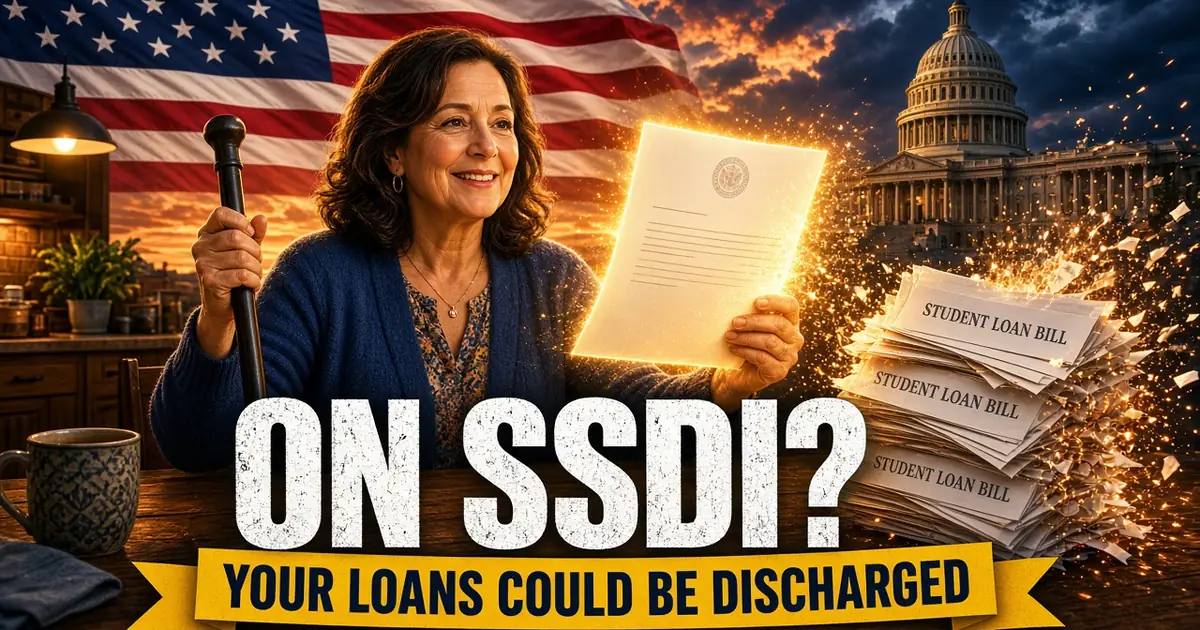
SSDI and SSI recipients can qualify for a TPD discharge when Social Security records show a disability status that the Department of Education accepts. If you qualify, the remaining balance on your eligible federal student loans is discharged and you no longer have to repay it. For the full program overview, see our TPD discharge guide.
Rules that took effect on July 1, 2023 widened who can qualify using Social Security documentation. These statuses likely qualify:
If your status is Medical Improvement Expected (MIE-E) and you have not been on benefits long, Social Security documentation alone likely will not qualify you yet. A medical certification may still work.
The Department of Education matches its records against Social Security data and sends notices to borrowers it identifies. Many people still fall through the cracks:
For discharges approved on or after July 1, 2023, there is no three-year income monitoring period. Payments made after the date your disability was established may be returned to you. Federal law now treats TPD discharges as tax-free at the federal level, though a few states may treat them differently. If you have defaulted loans, a discharge can also stop collections. Our default resolution service covers borrowers who do not qualify.
You send us your information. We do the rest:
Legal Touch handles these cases through our TPD Discharge Help service. See all of our Loan Help Services, including PSLF help.
Not automatically. SSDI or SSI can qualify you for a Total and Permanent Disability (TPD) discharge if your Social Security records show the right disability status. Many recipients are flagged through a federal data match, but others are missed and need an application filed with Social Security documentation or a medical certification.
A Medical Improvement Not Expected (MIE) review status likely qualifies. Since July 1, 2023, other statuses can also qualify, including Medical Improvement Possible when your disability was renewed after a review, a disability onset date at least five years ago, receiving SSDI or SSI for at least five years, and Compassionate Allowance conditions.
You can still apply. A doctor of medicine or osteopathy, a nurse practitioner, a physician assistant, or a licensed certified psychologist can certify that you cannot work because of a condition expected to last at least 60 months or result in death. Veterans with qualifying VA disability ratings may also qualify.
For discharges approved on or after July 1, 2023, the three-year income monitoring period was removed. Borrowers who were still in monitoring at that time were also released from it.
Federal Direct Loans, FFEL Program loans, and Federal Perkins Loans, plus TEACH Grant service obligations. Private student loans are not covered by TPD discharge.
No. The U.S. Department of Education decides every case. Legal Touch is not a law firm and makes no guarantees.
Find out in one call whether your disability status likely qualifies. Check My Eligibility or call 800-261-2946.
Questions first? Contact our team.
Legal Touch is not a law firm and does not give legal advice. Results are not guaranteed. Every decision is made by the U.S. Department of Education. You can apply for TPD discharge yourself for free at disabilitydischarge.com.

Attorney-formed document preparation for Title IV federal student loan program applications. Not a law firm.


Sales Key LLC dba Legal Touch Borrower Defense · (800) 261-2946 · Copyright . All rights reserved. Designed by Explore Logics
Sales Key LLC dba Legal Touch Borrower Defense, 641 E San Ysidro Blvd Num B3328, San Ysidro, CA 92173