By Aaron Hansome, Legal Touch. Working on Borrower Defense since May 2019. Last updated October 9, 2026.
Borrower Defense to Repayment is a federal program that can cancel your federal student loans if your school misled you or broke certain laws. It is run by the U.S. Department of Education, and the application is free at StudentAid.gov/borrower-defense.
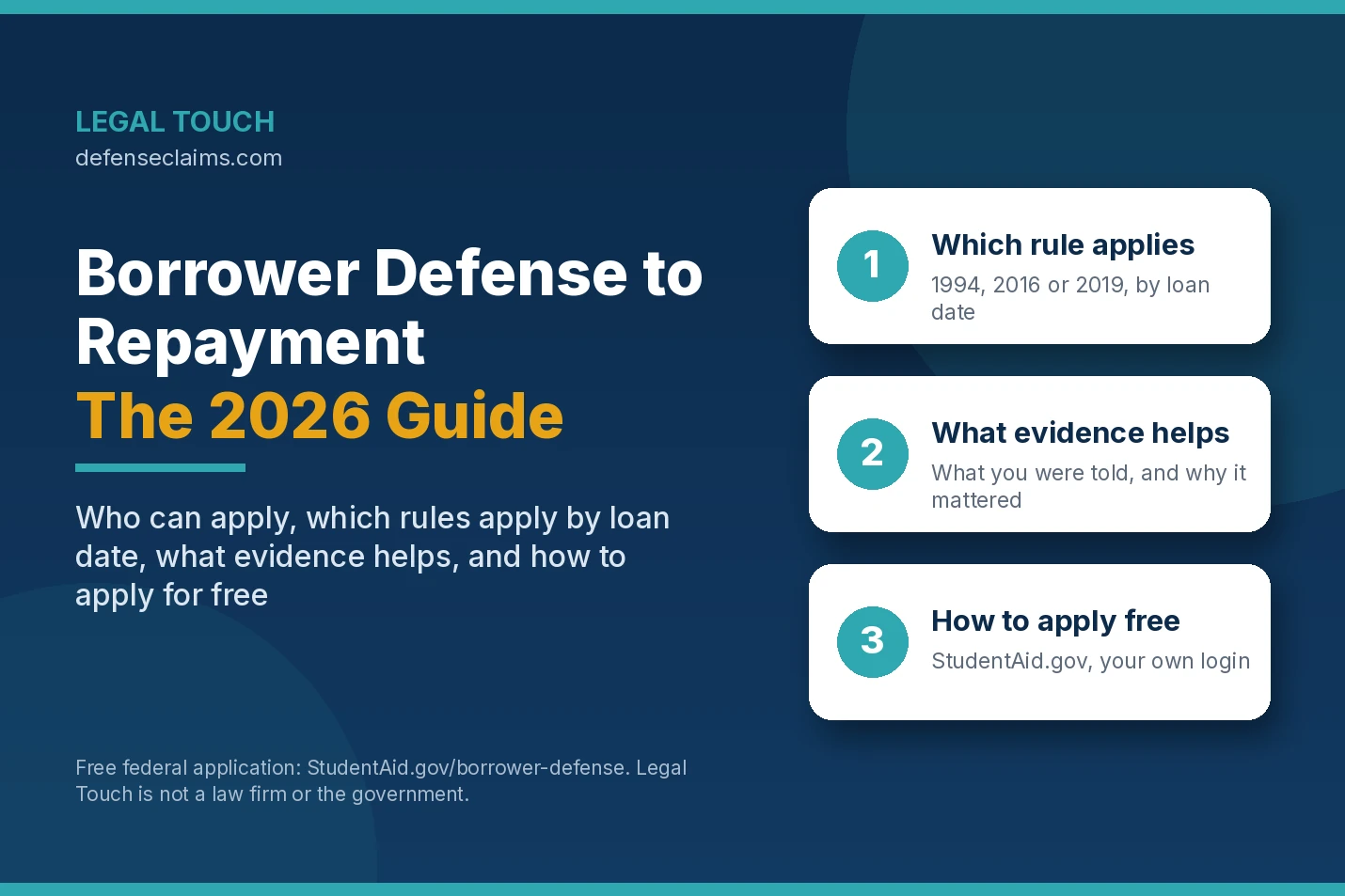
This plain-English guide covers who can apply, which rules apply to your loans, what evidence helps, how to apply for free, and where group discharges and the Sweet settlement fit in. It is general information, not legal advice.
Borrower Defense (often shortened to “BD”) lets you ask the Department of Education to cancel the federal loans you took out to attend a school that misled you. If you are approved, the Department can discharge all or part of those loans, and in some cases refund payments you already made.
Borrower Defense is not:
You may be able to apply if all of these are true:
You can apply even if you are still enrolled, have no paperwork, or are in default.
This is the part most people get wrong. The Department has written several versions of the Borrower Defense rules, and the one that applies depends on when each loan was first paid out (disbursed), or when it was consolidated. In July 2025, Congress kept the 2022 rule from applying to loans first originated before July 1, 2035 and put the 2019 rule back in place (Public Law 119-21, Sec. 85001).
| Loan first disbursed (or consolidated) | Rule used | What it means in plain English |
|---|---|---|
| Before July 1, 2017 | 1994 rule (34 CFR 685.206(c)) | Based on whether the school’s conduct would give you a claim under your state’s law. No application deadline while you still owe the loans |
| July 1, 2017 to June 30, 2020 | 2016 rule (34 CFR 685.222) | You show a “substantial misrepresentation” you reasonably relied on, or certain other school misconduct. No application deadline while you still owe the loans |
| July 1, 2020 or later | 2019 rule (34 CFR 685.206(e)) | Stricter standard and a 3-year filing limit from the date you left the school |
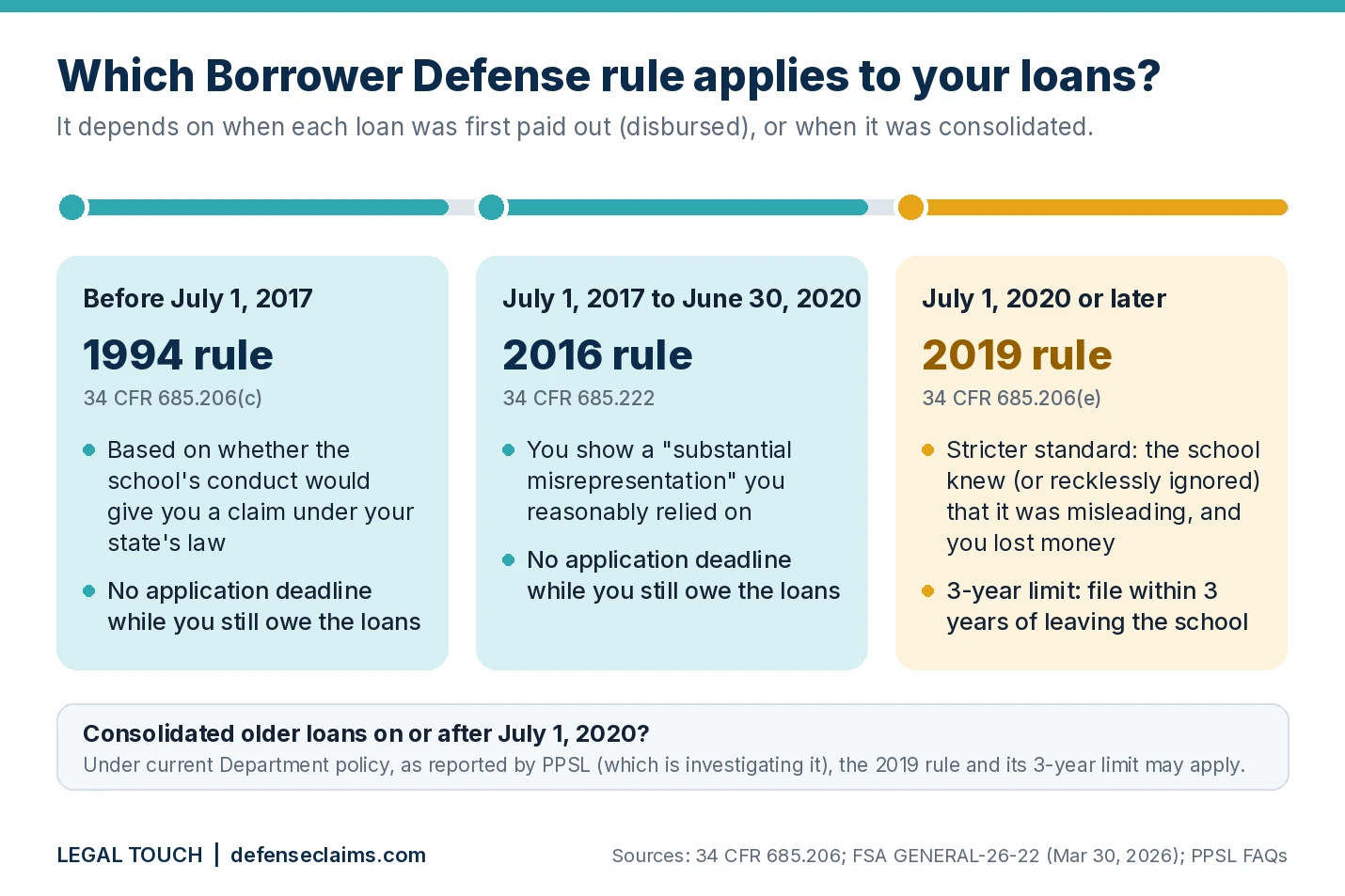
The 3-year limit comes from the 2019 rule, which covers many newer loans. Under that rule, you must file within 3 years from the date you were no longer enrolled at the school (34 CFR 685.206(e)(6)). For older loans under the 1994 and 2016 rules, Federal Student Aid said in March 2026 that “there is no time bar” on applying, as long as you still have active federal student loans.
The 2019 rule also asks for more. You have to show the school knew its statement was false or misleading (or recklessly ignored the truth), that you reasonably relied on it, and that you lost money because of it. If you were denied under the 3-year limit, read our article on Borrower Defense denials and the 3-year rule.
The Department’s own application form says that if you consolidated your loans, it evaluates your application “based upon when your loan was consolidated.” PPSL reports that the Department’s current policy is to decide claims under the 2019 rule for older loans that were consolidated into a Direct Consolidation Loan on or after July 1, 2020, so a time-limit denial can follow. This is the Department’s current policy, not a settled court ruling, and PPSL says it is investigating it. If your older loans were never consolidated, do not consolidate them without getting informed advice first.
Under the 2019 rule (34 CFR 685.206(e)(3)), examples of school misrepresentations include:
The older rules are different. The 2016 rule looks for a substantial misrepresentation you reasonably relied on, a breach of contract, or a court judgment against the school. The 1994 rule asks whether the school’s conduct would give you a claim under your state’s law. For real examples of documented school misconduct, see our usable misconduct library, and look up your school on our Borrower Defense school list.
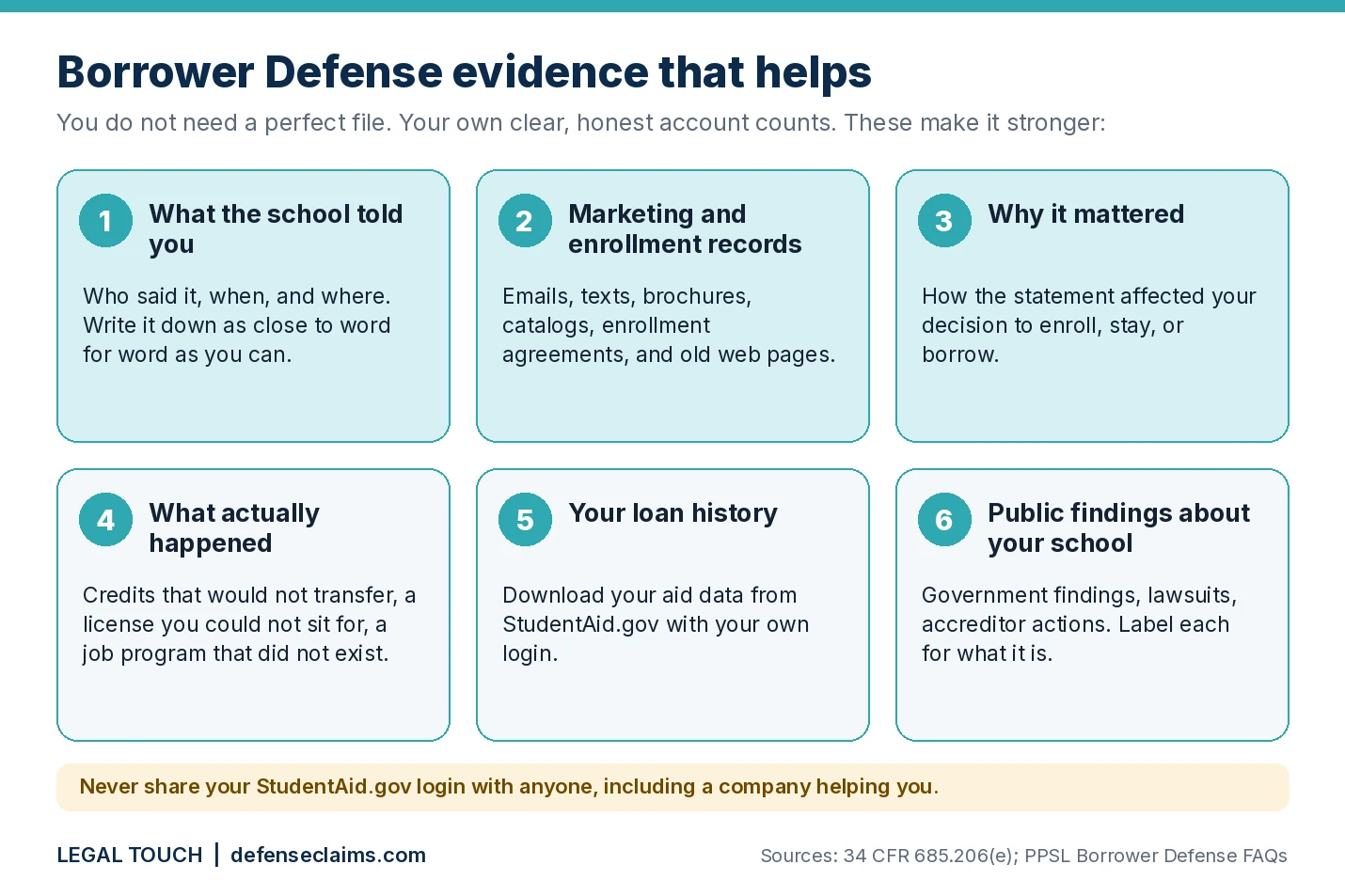
You do not need a perfect file. PPSL’s advice is to apply even if you did not keep paperwork, and to describe what happened in as much detail as you can. Your own clear, honest account counts. These records make it stronger:
There is no single official “Borrower Defense list.” Two kinds of lists matter.
Group discharges. For some schools, the Department found so much misconduct that it cancelled loans for whole groups of students, with no application needed. According to PPSL’s Group Discharges page, these include Corinthian Colleges (Everest, WyoTech, Heald), ITT Technical Institute, Westwood College, Marinello Schools of Beauty, the Art Institutes, the CEHE schools (CollegeAmerica, Stevens-Henager, Independence University, California College San Diego), Ashford University, Drake College of Business, and certain Globe University and Lincoln Tech programs, each for set enrollment dates. If you are covered, you should not pay anyone. If you attended outside the covered dates, or your school had a group approval limited to earlier applicants (as with DeVry and the University of Phoenix), the Department’s findings may still support your own application.
The Sweet v. McMahon settlement. This class action settlement covers many people who applied for Borrower Defense by November 15, 2022. Its “Exhibit C” list of schools (PDF) includes schools such as the University of Phoenix, Walden, Capella, and DeVry. Applicants from June 23 to November 15, 2022 are called “post-class” applicants. The court ruled that post-class applicants with no decision by January 28, 2026 (Exhibit C schools) or April 15, 2026 (other schools) are entitled to full settlement relief, and the Ninth Circuit upheld that on July 17, 2026 (PPSL case page). See our Sweet v. McMahon settlement page for more.
If you applied after November 15, 2022, you are not in the settlement, but you can still file or pursue a regular Borrower Defense claim.
Many people with older loans have Federal Family Education Loan (FFEL) or Perkins loans instead of Direct Loans. Borrower Defense discharges Direct Loans. The Department’s application says that if you are approved and some of your loans are non-Direct federal loans, it will consolidate them into a Direct Consolidation Loan “to the extent allowed by law and regulation if necessary to effectuate” the discharge.
That matters because consolidating on your own, on or after July 1, 2020, can move older loans under the 2019 rule and its 3-year limit under the Department’s current policy, as PPSL reports it. Our article on FFEL and Perkins loans and Borrower Defense consolidation explains how this works and how to check your loan types and dates. Before you consolidate anything:
Free help comes first:
Some people prefer paid help to organize their records and draft their application. That is what Legal Touch does. We are not a law firm, and we cannot promise any result. Before we take anyone on, we look at their dates and their school, and if a group discharge or the free StudentAid.gov route already covers them, we tell them that.
Yes. You can still apply for free at StudentAid.gov/borrower-defense. Which rule applies depends on your loan dates. See Is Borrower Defense Still Available in 2026?
Only for some loans. Loans under the 2019 rule (first disbursed or consolidated on or after July 1, 2020) have a 3-year limit from the date you left school. FSA says loans under the 1994 and 2016 rules have no application time bar while you still owe them.
Yes. Lists only show schools with group action or schools in the Sweet settlement. Anyone with eligible federal loans can file their own claim if the school misled them.
No. You can choose forbearance while your claim is pending, but interest keeps building and is cancelled only if you are approved. Forbearance months do not count toward income-driven repayment forgiveness or PSLF.
Yes. The application covers parents who borrowed for a child who attended the school.
Not without informed advice. Under the Department’s current policy, as reported by PPSL, consolidating older loans on or after July 1, 2020 can bring them under the 2019 rule and its 3-year limit. The application already lets the Department consolidate eligible loans if that is needed to carry out an approved discharge. See what to know about FFEL or Perkins loans before you consolidate.
No. Only the Department of Education decides Borrower Defense claims. Be wary of anyone who promises a result, quotes a success rate, or asks for your StudentAid.gov password.
Call Legal Touch at 800-261-2946 or request a free review at defenseclaims.com. We will look at your dates and your school, and if a group discharge or the free StudentAid.gov route already covers you, we will tell you that.
Legal Touch Borrower Defense is a private company. We are not a law firm, we do not give legal advice, and we are not affiliated with the U.S. Department of Education or any government agency. You can apply for Borrower Defense on your own, for free, at StudentAid.gov/borrower-defense. Results are not guaranteed. Only the Department of Education decides Borrower Defense claims. We will never ask for your StudentAid.gov username or password.
Sources
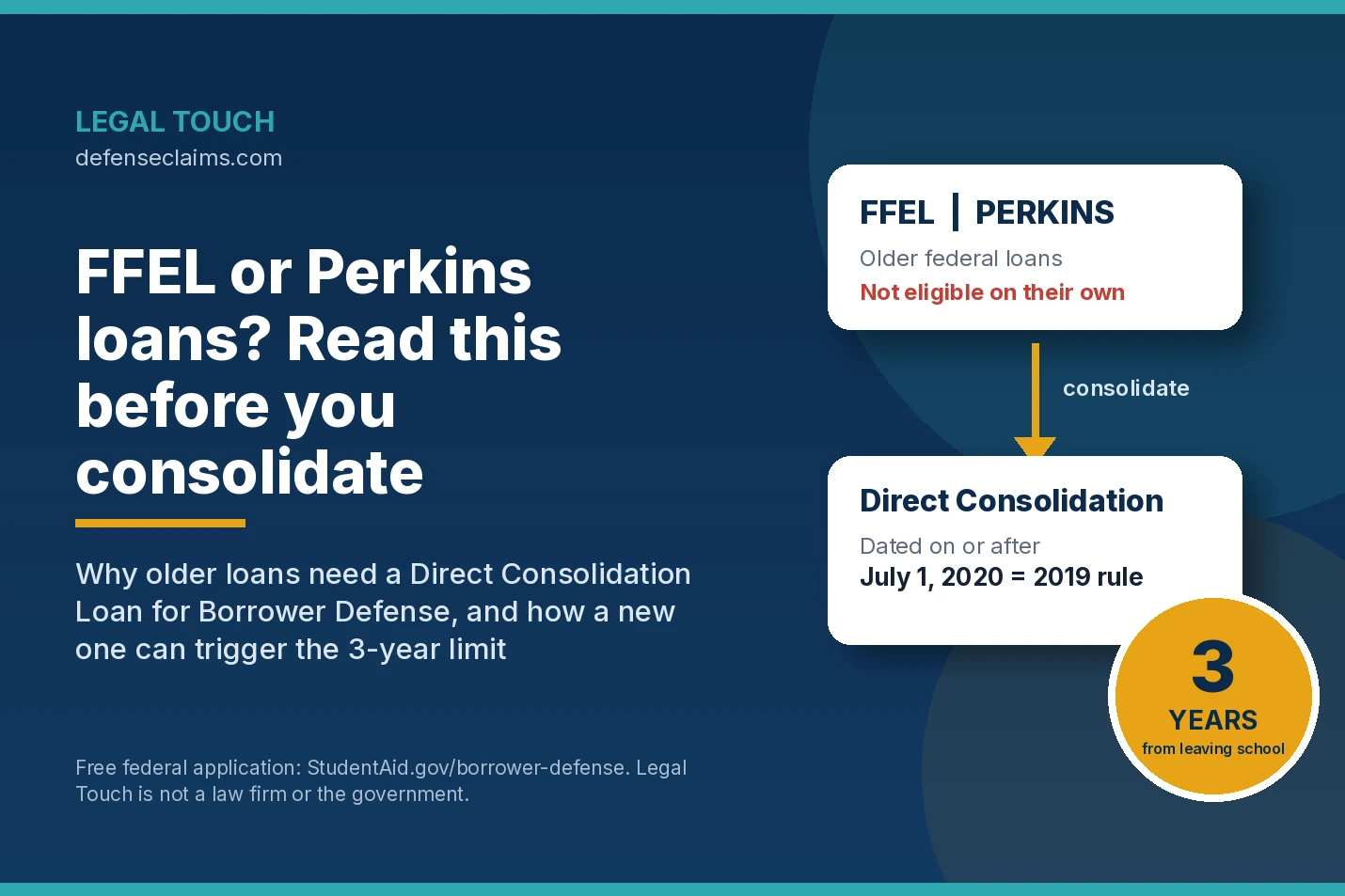
FFEL or Perkins loans? Consolidating on or after July 1, 2020 can trigger the Borrower Defense 3-year limit. Learn the rules and check your dates first....
Read More...
Denied under the Borrower Defense 3-year rule? Learn which loans the limit covers, how to read your letter, and what free options may still apply....
Read More...
Yes, you can still apply for Borrower Defense in 2026. Here is what changed, who faces the 3-year rule, and how to check your options for free....
Read More...
The highest level of education and consulting in Borrower Defense for Student Loans.

Legal Touch Borrower Defense - Copyright . All rights reserved. Designed by Explore Logics