If you opened a Borrower Defense denial letter this year and it mentioned a time limit, you are not alone. Borrowers on Reddit and in Facebook groups have been posting letters that cite the “2020 regulations” or say the application came in too late. Here is what is going on, in plain English, and what you can still check.
The short version: the 3-year limit is real, but it does not apply to everyone. It comes from the 2019 Borrower Defense rule, which covers many newer loans. Older loans judged under the 1994 or 2016 rules have no application deadline while you still owe them. Before you give up, find out which rule your letter used and whether another program already covers you.
In July 2025, Congress put the 2019 Borrower Defense rule back in place for federal loans first paid out on or after July 1, 2020 (Public Law 119-21, Sec. 85001). That rule (34 CFR 685.206(e)(6)) says a borrower must file within 3 years from the date the student is no longer enrolled at the school. The clock starts when you stopped attending, not when you found out the school misled you. The original 2019 rule also pauses the clock while an arbitration case under a school’s pre-dispute arbitration agreement is pending (84 FR 49788).
So if your loans fall under the 2019 rule and you left school more than 3 years before you applied, the Department can deny the claim without ever weighing your evidence.
This deadline does not apply to everyone. If your loans were first paid out before July 1, 2020 and you did not consolidate them on or after that date, the 1994 or 2016 rules apply. FSA said in March 2026 that under those rules “there is no time bar” on applying, as long as you still have active federal student loans. Our Borrower Defense guide explains which rule applies by loan date.
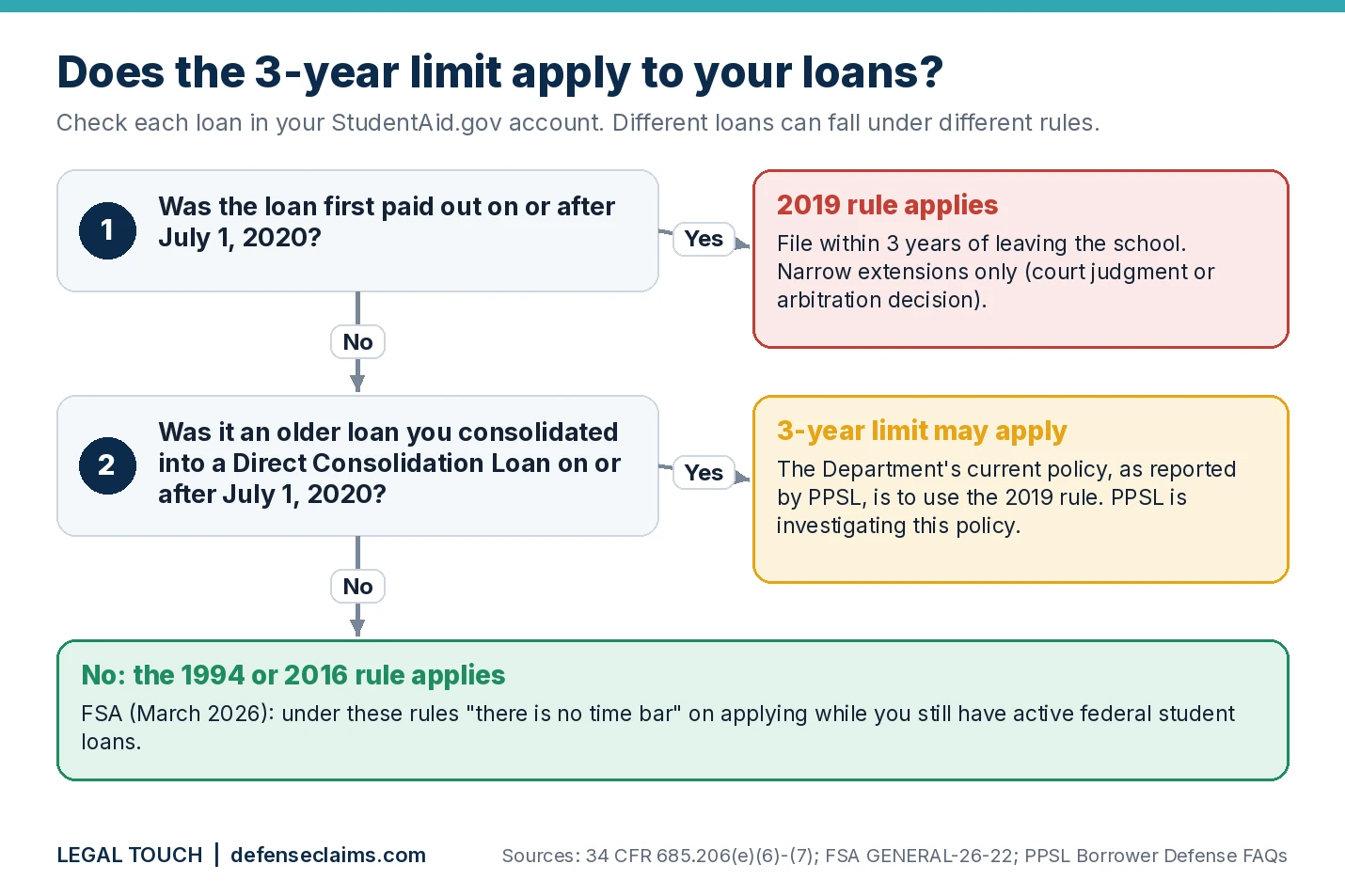
This can catch people who took out their loans years ago. The Project on Predatory Student Lending (PPSL) reports that if you borrowed before July 1, 2020 but later consolidated into a Direct Consolidation Loan on or after July 1, 2020, the Department’s current policy is to decide your claim under the 2019 rule, so a time-limit denial can follow. Many borrowers consolidated in 2021 to 2024 for income-driven repayment or Public Service Loan Forgiveness without knowing it could matter for Borrower Defense.
If you still have FFEL or Perkins loans, read our guide to FFEL or Perkins loans and consolidation before you change anything.
Keep two things in mind. First, this is the Department’s current policy as PPSL reports it, not a settled court ruling, and PPSL says it is investigating it. Second, PPSL has asked borrowers who applied after November 15, 2022 and were recently denied to contact it (see the r/BorrowerDefense action alert).
Look for three things:
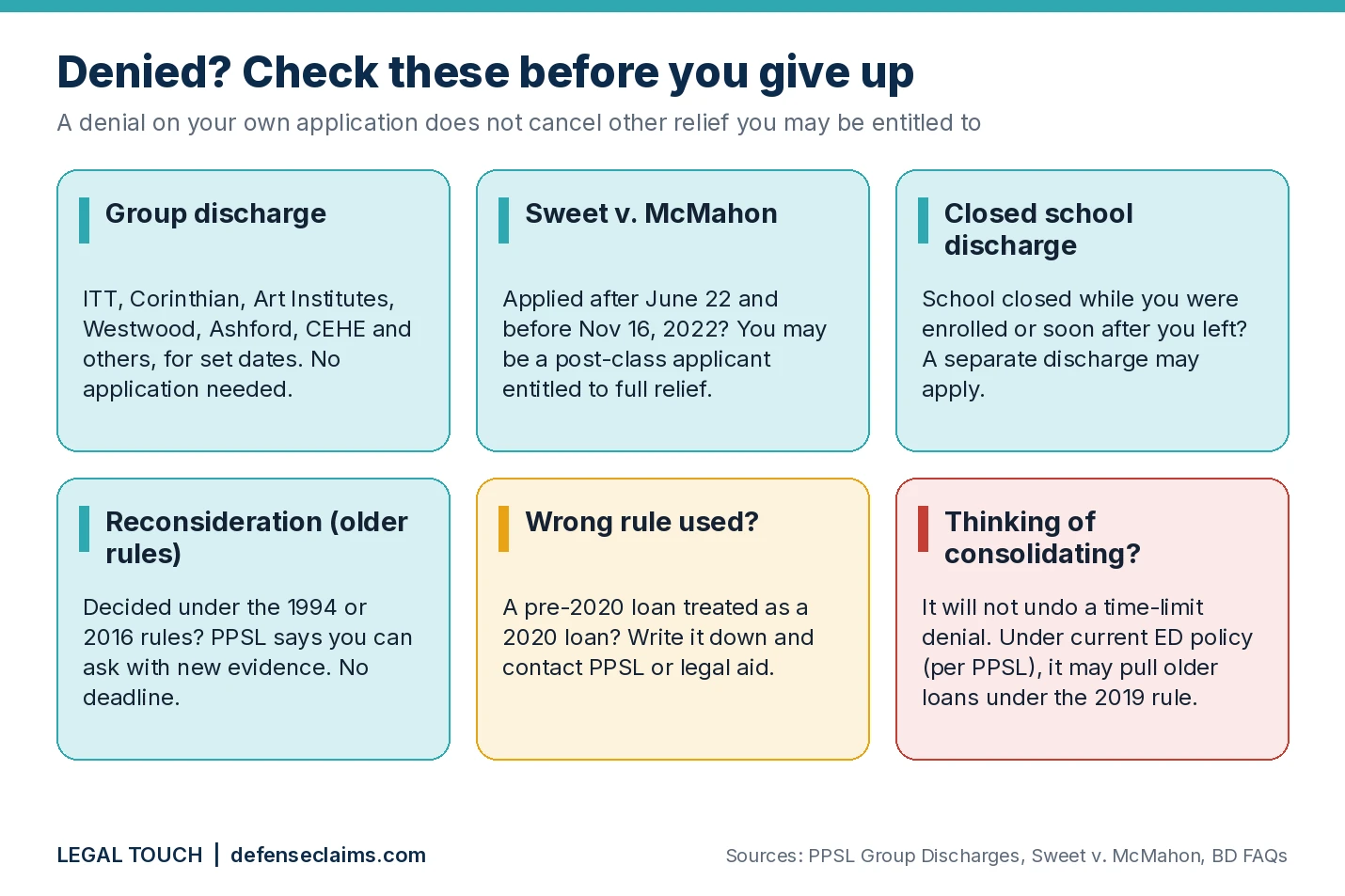
A denial on your individual application does not cancel other relief you may be entitled to.
This is the hard part. Under the 2019 rule, the Department’s written decision is final and “not subject to appeal within the Department” (34 CFR 685.206(e)(13)). For these loans, the rule lets the Department extend the time limit or reopen an application only if there is a final court judgment or a final arbitration decision establishing that the school made a misrepresentation (685.206(e)(7)).
If your claim was decided under the 1994 or 2016 rules instead, PPSL’s guidance says you can ask for reconsideration with new evidence and a detailed explanation, and that there is no deadline for that request.
If you think your loans were placed under the wrong rule, for example because the denial treats a pre-2020 loan as a 2020 loan, write that down and contact PPSL. You can also talk to a legal aid office or a consumer attorney about whether a court option exists. Legal Touch is not a law firm and cannot give you legal advice on that question.
Do not consolidate to “fix” a denial. A new consolidation will not undo a time-limit decision. Under the Department’s current policy as PPSL reports it, consolidating older loans now could even pull them under the 2019 rule. The Department’s Borrower Defense application already lets it consolidate eligible FFEL loans if that is needed to carry out an approved discharge.
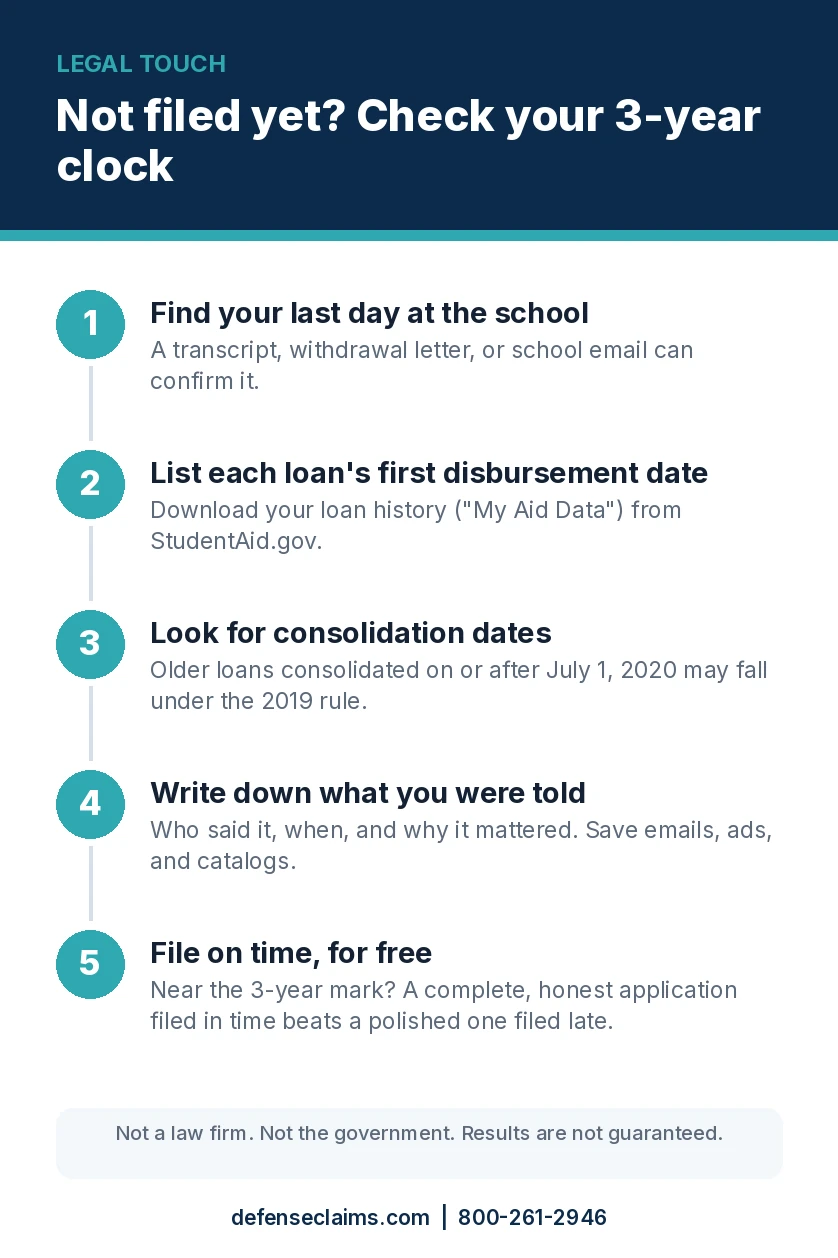
If you have not filed and your loans are under the 2019 rule, your 3-year clock may still be running. Find your last date of attendance and each loan’s first disbursement date in your StudentAid.gov account before you do anything else. If you are close to the 3-year mark, do not wait to perfect your story. A complete, honest application filed in time is better than a polished one filed late. You can apply for free at StudentAid.gov/borrower-defense, and our free Borrower Defense DIY guide walks through the form.
What to gather:
If your claim falls under the 2019 rule and you are past the 3-year window, no company, including ours, can make the Department weigh your evidence. Anyone who promises otherwise is not being straight with you. What we can do is look at your dates, your school, and your loan history and tell you whether a group discharge, the Sweet settlement, a closed school discharge, or a timely new claim might apply. If the free route already covers you, we will tell you that.
“I’ve worked on Borrower Defense since May 2019, and the first thing I look at is not the story. It’s the dates,” says Aaron Hansome of Legal Touch. “If the dates rule someone out, they deserve to hear that on the first call, along with anything free that might still help.”
Call Legal Touch at 800-261-2946 or request a free review at defenseclaims.com. Bring your denial letter and your StudentAid.gov loan history if you have them. New to Borrower Defense? Start with Is Borrower Defense Still Available in 2026?
Legal Touch Borrower Defense is a private company. We are not a law firm, we do not give legal advice, and we are not affiliated with the U.S. Department of Education or any government agency. You can apply for Borrower Defense on your own, for free, at StudentAid.gov/borrower-defense. Results are not guaranteed. Only the Department of Education decides Borrower Defense claims. We will never ask for your StudentAid.gov username or password.
Sources
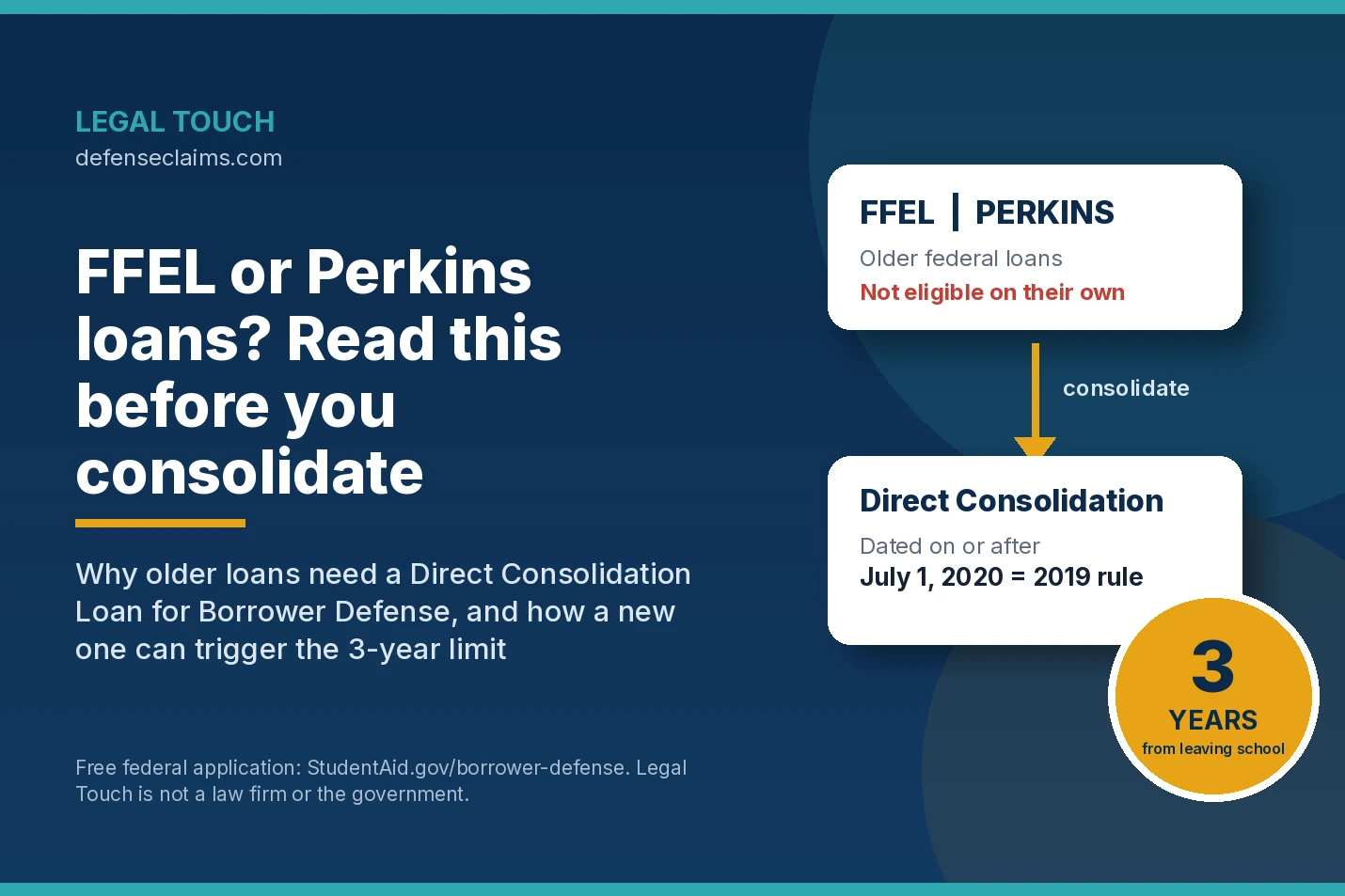
FFEL or Perkins loans? Consolidating on or after July 1, 2020 can trigger the Borrower Defense 3-year limit. Learn the rules and check your dates first....
Read More...
Yes, you can still apply for Borrower Defense in 2026. Here is what changed, who faces the 3-year rule, and how to check your options for free....
Read More...
The highest level of education and consulting in Borrower Defense for Student Loans.

Legal Touch Borrower Defense - Copyright . All rights reserved. Designed by Explore Logics