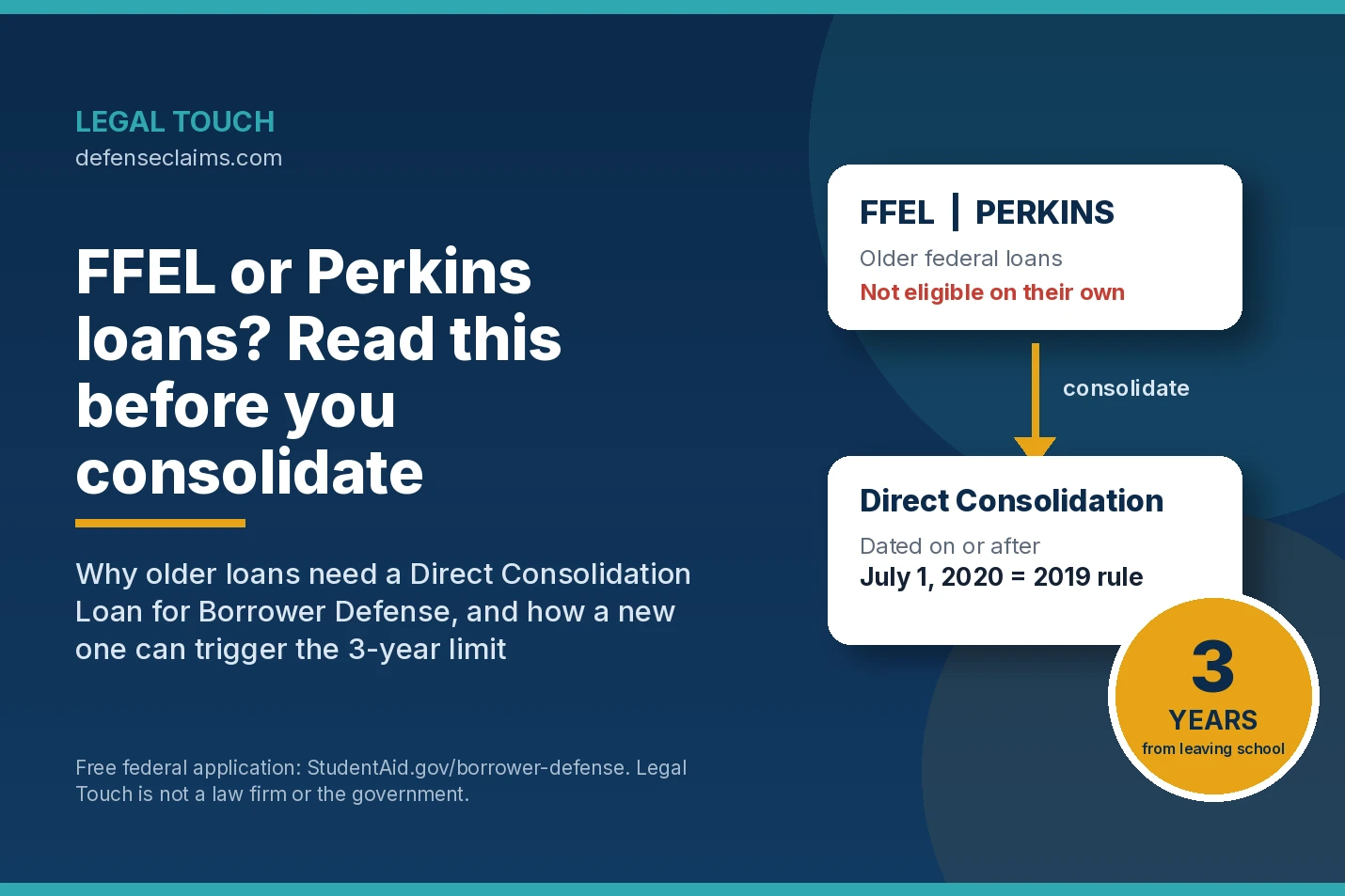
If you went to school before 2010, some of your federal student loans may be FFEL or Perkins Loans, not Direct Loans. That matters a lot for Borrower Defense, especially if someone told you to “just consolidate” before you apply. Here is how it works, in plain English.
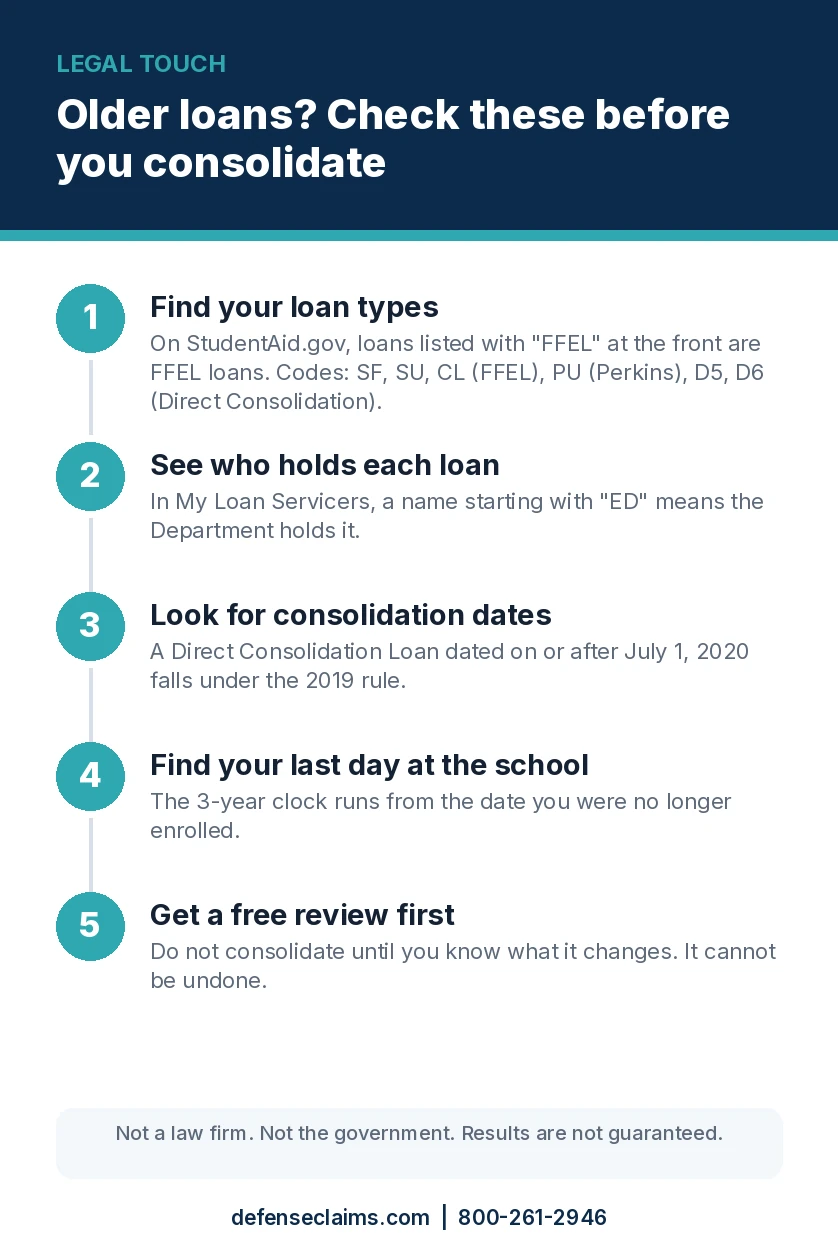
The short version: FFEL and Perkins loans have never qualified for a Borrower Defense discharge on their own. In the past, borrowers could consolidate them into a Direct Consolidation Loan to make them eligible. Today, a consolidation dated on or after July 1, 2020 puts the new loan under the 2019 rule, and that triggers the same 3-year filing limit, counted from your last date of attendance, that applies to newer loans. So do not consolidate first. Get your dates reviewed first.
FFEL (the Federal Family Education Loan Program) loans were made by private lenders and backed by the federal government. They include FFEL Stafford, FFEL PLUS, and FFEL Consolidation Loans. Federal Student Aid says the FFEL Program ended July 1, 2010, and that most FFEL loans are held by a guaranty agency or a commercial lender, though some are held by the Department of Education.
Perkins Loans were federal loans made through a school’s financial aid office.
Since 2010, new federal student loans have been Direct Loans, made by the Department of Education.
Borrower Defense to Repayment is part of the Direct Loan Program rules. The older rules, 34 CFR 685.206(c) and 34 CFR 685.222, are written as defenses to repaying a Direct Loan. The 2019 rule, 34 CFR 685.206(e)(1)(iii), covers a Direct Loan or a Direct Consolidation Loan that was used to repay an FFEL, Perkins, or other listed federal loan. In other words, an FFEL or Perkins loan can only be discharged through Borrower Defense once it is inside a Direct Consolidation Loan.
That does not mean FFEL borrowers are shut out of applying. The official Borrower Defense application (PDF) covers the Direct Loan, FFEL, and Perkins programs. If your application is approved and some of your loans are not Direct Loans, the form says you agree the Department will consolidate them into a Direct Consolidation Loan “to the extent allowed by law and regulation if necessary to effectuate” the discharge.
One more rule from the Project on Predatory Student Lending (PPSL): you need at least one outstanding federal loan from the school that misled you. If those loans are already paid off, the application will not be accepted.
For years, consolidation was the way in. An FFEL or Perkins borrower could consolidate into a Direct Consolidation Loan, and the new loan could then be discharged through Borrower Defense. A Direct Consolidation Loan made before July 1, 2020 is judged under the 1994 rule or the 2016 rule, depending on its date. Our Borrower Defense guide to which rules apply by loan date has the full table. In March 2026, Federal Student Aid said that under those two rules “there is no time bar” on applying, as long as you still have active federal student loans.
The catch is the date of the consolidation. The Borrower Defense application says it plainly: “if you consolidated your loans we evaluate your application based upon when your loan was consolidated.” Loans taken out or consolidated on or after July 1, 2020 are evaluated under the 2019 rule, 34 CFR 685.206(e). When the Department wrote that rule in 2019, it said the standard for a Direct Consolidation Loan depends on the date the consolidation loan was first disbursed, and it admitted this “may deter some borrowers” who did not want to face the new standard and its time limits (84 FR 49788).
In July 2025, Congress put the 2019 rule back in place for loans first made before July 1, 2035 (Public Law 119-21, Sec. 85001). So a consolidation made today falls under the 2019 rule.
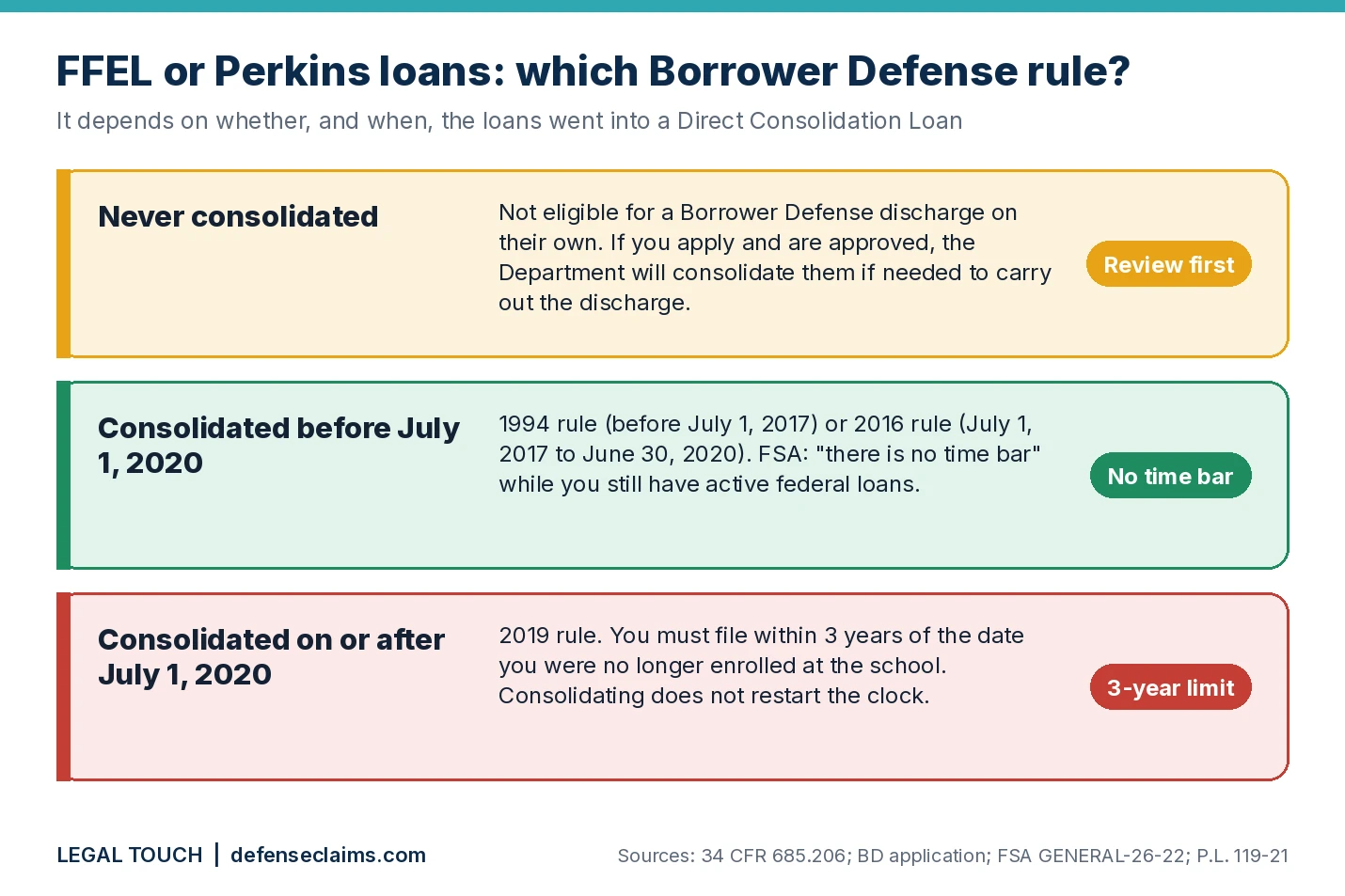
Under the 2019 rule, you must file within 3 years from the date you were no longer enrolled at the school (34 CFR 685.206(e)(6)). This is the same limit we explain in our article on the 3-year filing limit from your last date of attendance. The clock runs from your last day at the school, not from the day you consolidated and not from the day you found out the school misled you.
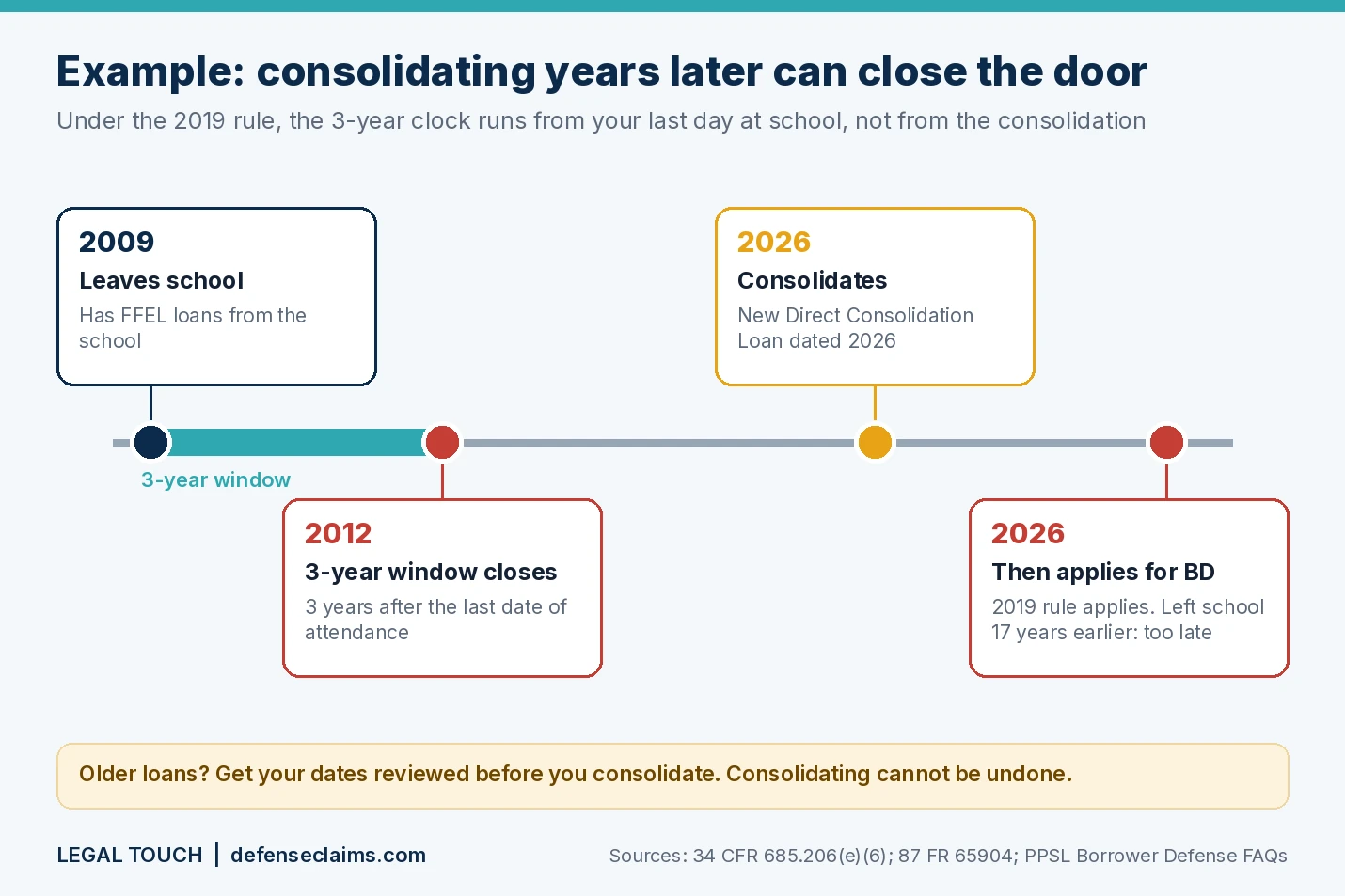
Picture someone who left school in 2009 with FFEL loans and consolidates in 2026. The new Direct Consolidation Loan is dated 2026, so it falls under the 2019 rule. But their 3-year window closed in 2012. Consolidating did not open a door. It may have closed one.
This is not just a theory. In its 2022 rulemaking, the Department said it had done initial reviews of some 2019-rule claims tied to borrowers consolidating older loans and “found that all of them would have been barred by the regulation’s statute of limitations” (87 FR 65904). PPSL also reports that the Department’s current policy is to decide claims on older loans consolidated on or after July 1, 2020 under the 2019 rule, and that “your application might be denied based on the time limit.” PPSL says it is investigating that policy, so it could change.
Consolidation is not automatically good or bad. Federal Student Aid and the CFPB list real tradeoffs:
Consolidation can also open doors, like more repayment plans and Public Service Loan Forgiveness (CFPB). The right answer depends on your loans, your dates, and your goals. That is why the first step is a review, not a consolidation.
If you see a Direct Consolidation Loan dated July 1, 2020 or later that includes your school’s loans, and you left that school more than 3 years ago, talk to someone before you file. If you still have FFEL or Perkins loans from that school, do not consolidate until you understand what it changes.
“I’ve worked on Borrower Defense since May 2019, and the first thing I look at is not the story. It’s the dates,” says Aaron Hansome of Legal Touch. “If the dates rule someone out, they deserve to hear that on the first call, along with anything free that might still help.”
Not on their own. Borrower Defense discharges Direct Loans and Direct Consolidation Loans. If you are approved and some of your loans are FFEL or Perkins, the application says the Department will consolidate them if that is needed to carry out the discharge.
Not without a review first. A consolidation made on or after July 1, 2020 puts the new loan under the 2019 rule, which has a 3-year filing limit counted from your last date of attendance. If you left school more than 3 years ago, consolidating first could make you miss that limit.
A Direct Consolidation Loan made before July 1, 2017 falls under the 1994 rule, and one made from July 1, 2017 to June 30, 2020 falls under the 2016 rule. FSA says those rules have no application time bar while you still have active federal student loans.
No. Under the 2019 rule, the 3 years run from the date you were no longer enrolled at the school.
Yes. Anyone can apply for free at StudentAid.gov/borrower-defense.
Before you consolidate or change your federal loans, call Legal Touch at 800-261-2946 or request a free review at defenseclaims.com. Have your aid data file or StudentAid.gov loan list handy. We will go through your loan types and dates with you and tell you honestly what we see, including if another option fits better, like a group discharge, the Sweet settlement, or a closed school discharge. New to all this? Start with our Borrower Defense guide, read whether Borrower Defense is still available in 2026, or use our free Borrower Defense DIY guide to apply on your own.
Legal Touch Borrower Defense is a private company. We are not a law firm, we do not give legal advice, and we are not affiliated with the U.S. Department of Education or any government agency. You can apply for Borrower Defense on your own, for free, at StudentAid.gov/borrower-defense. Results are not guaranteed. Only the Department of Education decides Borrower Defense claims. We will never ask for your StudentAid.gov username or password.
Sources
Project on Predatory Student Lending, Borrower Defense FAQs
Denied under the Borrower Defense 3-year rule? Learn which loans the limit covers, how to read your letter, and what free options may still apply....
Read More...
Yes, you can still apply for Borrower Defense in 2026. Here is what changed, who faces the 3-year rule, and how to check your options for free....
Read More...
The highest level of education and consulting in Borrower Defense for Student Loans.

Legal Touch Borrower Defense - Copyright . All rights reserved. Designed by Explore Logics