If your federal student loans are in default, you have two main ways out: loan rehabilitation and Direct Loan consolidation. Both stop the default, end most collections, and bring back benefits like income-driven repayment, deferment, and forbearance. But they work very differently. One is better for your credit. The other is faster. Picking the wrong one can cost you months or leave a default mark you did not need to keep. Legal Touch reviews your loans and handles the process for you.
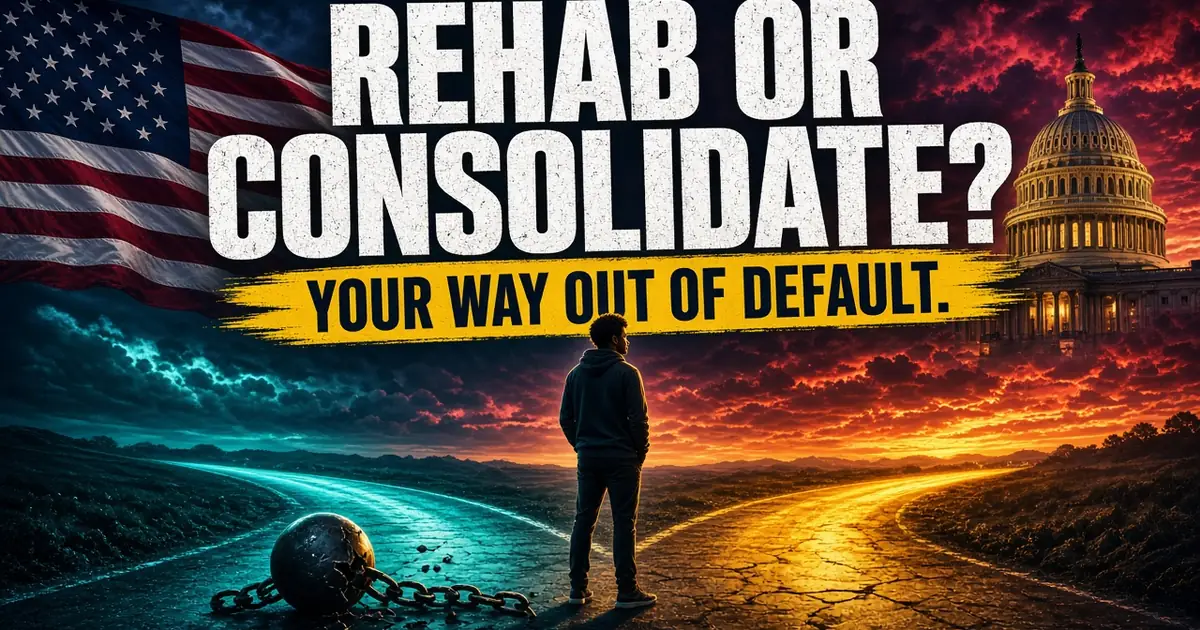
Choose rehabilitation if your credit report matters most and you can wait about nine to ten months. Choose consolidation if you need out of default quickly, for example to stop a tax refund offset or wage garnishment, or if you already used rehabilitation on that loan. Many borrowers likely qualify for both, and the right choice depends on your loan types, your timeline, and whether a discharge might cancel the loans instead.
Rehabilitation is an agreement with the holder of your defaulted loan. You make nine voluntary, on-time monthly payments within a 10-month window, each within 20 days of the due date. Perkins Loans require nine payments in a row.
A Direct Consolidation Loan pays off your defaulted loans with a new federal loan that starts in good standing. To consolidate a defaulted loan, one of these must happen first:
| Question | Rehabilitation | Consolidation |
|---|---|---|
| How long does it take? | About 9 to 10 months | Often a few weeks to a couple of months |
| Removes default from credit report? | Yes | No, but the loans show as paid |
| Monthly cost while in process | Income-based, as low as $5 today | Usually nothing extra once the new loan is made |
| What Legal Touch charges | Nothing. Rehabilitation is free through the Default Resolution Group at 1-800-621-3115 | $495 flat fee |
| How often can it be used? | Once per loan now, twice starting July 1, 2027 | Generally once for defaulted loans being consolidated |
| Stops wage garnishment? | Can be suspended after 5 payments | Can end when the new loan is made |
Before fixing a default, it is worth asking whether you even owe the debt. If your school misled you, closed while you were enrolled, or you have a lasting disability, your loans may qualify for Borrower Defense or a Total and Permanent Disability discharge. Consolidation can also affect some of these options, so the order matters. We check them before anything is filed.
You tell us about your loans. We do the work:
Our default resolution service for consolidation is a $495 flat fee if you are eligible. Rehabilitation is free: you can set it up yourself with the U.S. Department of Education's Default Resolution Group at 1-800-621-3115. See all of our Loan Help Services, including PSLF help and our guide to SSDI and TPD discharge.
Rehabilitation is usually better for credit. When rehabilitation is complete, the default notation is removed from your credit report, although late payments reported before the default stay. Consolidation pays off the defaulted loans, but the default record itself stays on your history.
Consolidation is usually faster. A Direct Consolidation Loan can often be completed in a few weeks to a couple of months. Rehabilitation takes at least nine monthly payments over a 10-month period.
Rehabilitation payments are based on your income and family size, so they can be very low. Today the minimum can be as low as $5 a month. For Direct Loans made on or after July 1, 2027, the minimum rises to $10.
Right now, each loan can be rehabilitated only once. Starting July 1, 2027, federal law allows a loan to be rehabilitated up to two times over its lifetime. If you already used rehabilitation, consolidation is often the remaining route.
Both can end collections once the loan is out of default. During rehabilitation, you can usually ask to suspend administrative wage garnishment after five qualifying payments. Consolidation can stop garnishment when the new loan is made, but an active garnishment order or a court judgment can block consolidation until it is lifted.
Yes. If you likely qualify for Borrower Defense, a closed school discharge, or a Total and Permanent Disability discharge, your loans may be canceled instead of repaid. Legal Touch checks these first.
Rehabilitation is free. You can set it up yourself with the U.S. Department of Education's Default Resolution Group at 1-800-621-3115. Legal Touch does not charge for rehabilitation. If you are eligible, Legal Touch offers default resolution by consolidation for a $495 flat fee.
No. Your loan holder and the U.S. Department of Education make every decision. Legal Touch is not a law firm and makes no guarantees.
Find out in one call which way out of default likely fits you best. Check My Eligibility or call 800-261-2946.
Questions first? Contact our team.
Legal Touch is not a law firm and does not give legal advice. Results are not guaranteed. Every decision is made by the U.S. Department of Education. You can resolve a default yourself for free by working with your loan holder or through StudentAid.gov.

Attorney-formed document preparation for Title IV federal student loan program applications. Not a law firm.


Sales Key LLC dba Legal Touch Borrower Defense · (800) 261-2946 · Copyright . All rights reserved. Designed by Explore Logics
Sales Key LLC dba Legal Touch Borrower Defense, 641 E San Ysidro Blvd Num B3328, San Ysidro, CA 92173