If your federal student loans are in default, two questions probably keep coming up: will the government take money from my paycheck, and will it take my tax refund? Right now the answer is no. Both kinds of collections are paused. But the pause has no end date, and in October 2026 several news outlets reported that a restart is being planned for 2027. Here is how wage garnishment and Treasury offset work, what notices to watch for, and why this quiet period is the best time to get out of default.
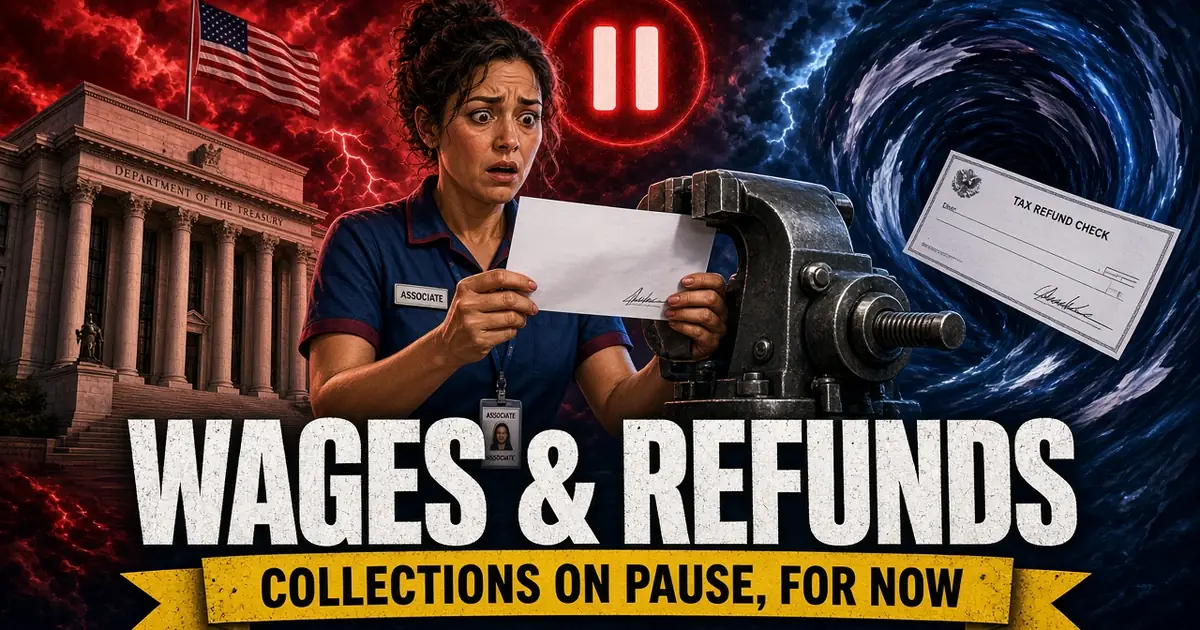
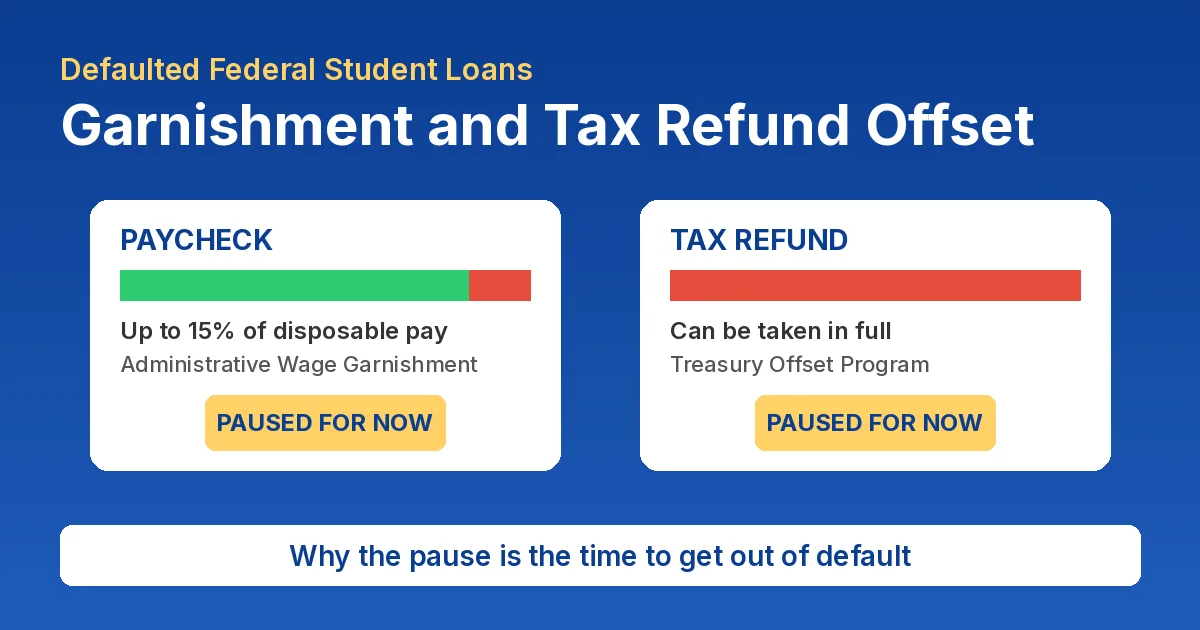
On January 16, 2026, the U.S. Department of Education delayed involuntary collections on federal student loans, including Administrative Wage Garnishment (AWG) and the Treasury Offset Program (TOP). Federal Student Aid still says both are paused, and it is not withholding tax refunds from defaulted borrowers. The delay was described as temporary. When collections come back, borrowers who are still in default will be first in line, so the safest move is to resolve the default while nothing is being taken.
According to Federal Student Aid data reported by NASFAA, more than 9.3 million borrowers were in default as of June 30, 2026, owing about $234 billion, or roughly 14% of the federally managed loan portfolio. That number grew by about 400,000 in a single quarter. Another 1.5 million borrowers were in late-stage delinquency and at risk of default. Most federal loans go into default after about 270 days without a payment.
In mid-October 2026, news outlets reported that the Treasury Department was preparing to hire private debt collectors, possibly as soon as November, and that officials were discussing a broader restart of collections in 2027. Some reportedly favor a restart tied to the April 15, 2027 tax deadline, while others want to wait until the new support portal is working smoothly. When asked, the Department told Yahoo Finance that "involuntary collections remain paused." No restart date has been announced, so treat any specific date you hear as a report, not a rule.
Federal Student Aid says that submitting a signed Direct Consolidation Loan application by the date on a notice of intent to offset is one of the ways to avoid the offset.
Under the Federal Student Aid rules for getting out of default, a defaulted loan can be consolidated into a new Direct Consolidation Loan if one of these is true:
For a side by side look at both paths, see our guide to rehabilitation vs. consolidation.
On September 30, 2026, the Education and Treasury Departments launched the Defaulted Loans Support Center on StudentAid.gov. It lets defaulted borrowers compare paths out of default, apply online for rehabilitation or consolidation, make payments, and review repayment and discharge options. The Department says consolidation applicants who enroll in autopay can also get a temporary interest rate reduction. The portal is free. So is the Department of Education's Default Resolution Group at 1-800-621-3115.
You tell us about your loans once. We do the work:
Default resolution by consolidation is a $495 flat-fee Legal Touch service for eligible borrowers. If consolidation does not fit your situation, we will tell you, and the Department's Default Resolution Group at 1-800-621-3115 can walk you through other options. You can see all of our loan help services in one place.
Related reading: choosing a repayment plan after SAVE, whether SSDI qualifies you for a TPD discharge, and our federal loan consolidation guide.
No. On January 16, 2026, the U.S. Department of Education delayed Administrative Wage Garnishment and the Treasury Offset Program for defaulted federal student loans, and Federal Student Aid still describes both as paused. No restart date has been announced.
Nobody can say for sure yet. In October 2026, news outlets reported that officials were discussing a restart of collections in 2027, possibly around the April 15, 2027 tax deadline, but the Department has not confirmed any date. If offset resumes and your loans are still in default, a federal refund can be taken in full, including refundable credits.
Administrative Wage Garnishment can take up to 15% of disposable pay without a court order. The Department must first mail a notice at least 30 days before the garnishment starts, and that notice explains the right to a hearing and the option of a voluntary repayment agreement.
Yes, when Treasury offset is active. Federal rules limit the offset of a monthly Social Security benefit to the smallest of the debt, 15% of the benefit, or the amount above $750. SSI payments cannot be offset.
Once a defaulted loan is paid off by a new Direct Consolidation Loan, it is no longer in default, so it is no longer subject to these collections. A loan that is already under a wage garnishment order generally cannot be consolidated until the order is lifted, which is one reason the current pause is a good time to act.
To consolidate a defaulted loan, the borrower must either agree to repay the new loan on an income-driven plan or first make three voluntary, on-time, full monthly payments on the defaulted loan. For consolidation loans made on or after July 1, 2026, the only income-driven plan is the Repayment Assistance Plan (RAP), and a consolidation that includes a Parent PLUS loan cannot use RAP.
It is an online portal on StudentAid.gov that the Education and Treasury Departments launched on September 30, 2026. It explains default and lets borrowers apply for rehabilitation or consolidation, make payments, and review repayment and discharge options. It is free to use.
No. Your loan holder and the U.S. Department of Education make every decision. Legal Touch is not a law firm and makes no guarantees. What we do is make sure your consolidation application is complete, on the right plan, and filed before any deadline we know about.
Find out whether your loans are in default, whether you likely qualify to consolidate, and whether a discharge may fit better. Check My Eligibility or call 800-261-2946.
Questions first? Contact our team.
Sources: U.S. Department of Education, press release, January 16, 2026; Federal Student Aid, Collections and Getting Out of Default; U.S. Department of the Treasury, Defaulted Loans Support Center launch, September 30, 2026; NASFAA, September 25, 2026; Yahoo Finance; 31 CFR Part 285; Massachusetts Attorney General student loan assistance.
Legal Touch is not a law firm and does not give legal advice. Results are not guaranteed. Every decision is made by the U.S. Department of Education or your loan holder, and Legal Touch is not affiliated with any government agency. You can resolve a default yourself, for free, through the Defaulted Loans Support Center or by calling the Default Resolution Group at 1-800-621-3115. We will never ask for your StudentAid.gov username or password.

Attorney-formed document preparation for Title IV federal student loan program applications. Not a law firm.


Sales Key LLC dba Legal Touch Borrower Defense · (800) 261-2946 · Copyright . All rights reserved. Designed by Explore Logics
Sales Key LLC dba Legal Touch Borrower Defense, 641 E San Ysidro Blvd Num B3328, San Ysidro, CA 92173