Getting a total and permanent disability (TPD) discharge is a major step, but for many borrowers the story does not end on approval day. If your discharge came through Social Security documents or a medical professional certification, Federal Student Aid still runs a three-year post-discharge monitoring period. One move during that window, especially taking a new Direct Loan or a new TEACH Grant, can bring the old debt back. Here is what changed, what still matters in 2026, and how Legal Touch handles the work for you.
According to Federal Student Aid's after-you-apply page:
| How the discharge was approved | Post-discharge monitoring | What can reinstate the debt | Federal tax note |
|---|---|---|---|
| Social Security Administration documents or a physician, physician assistant, or nurse practitioner certification | Three-year period that starts on the discharge date | A new Direct Loan or a new TEACH Grant during the three years (Parent PLUS for a child counts as a new Direct Loan) | Federal law permanently excludes TPD discharge from federal taxable income; state tax may differ |
| U.S. Department of Veterans Affairs documentation | None | No post-discharge monitoring period under current Federal Student Aid rules | Same federal exclusion for TPD; confirm state rules with a tax professional |
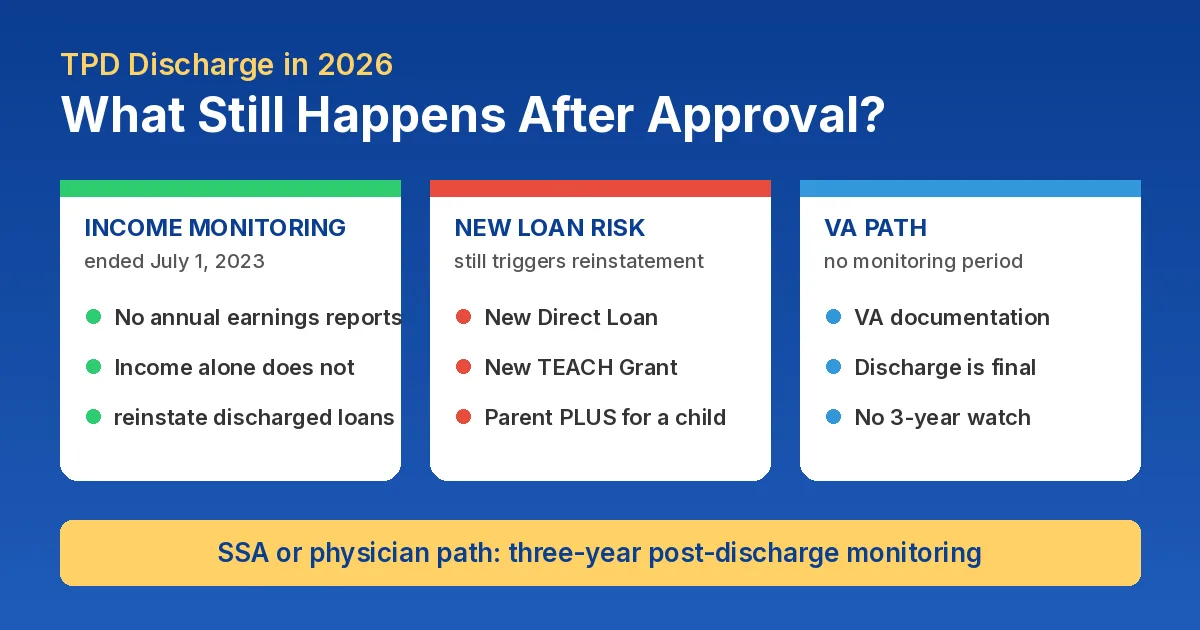
The monitoring period starts on the date the Department of Education grants the discharge and lasts three years. During that time, the Department watches for new Title IV borrowing. Federal Student Aid states that if you receive a new student loan under the Direct Loan Program or a new TEACH Grant during monitoring, you lose the TPD discharge and the previously discharged loans (and any TEACH Grant service obligation) are reinstated.
That is why families sometimes get surprised by a Parent PLUS loan for a child. Parent PLUS is a Direct Loan. Taking it out during the three-year window is treated like any other new Direct Loan and can reinstate the discharged balance. See our guide to Parent PLUS repayment and forgiveness before any new borrowing is filed.
Other technical reinstatement risks can appear in older Department forms, such as failing to return a pre-discharge disbursement within 120 days, or an SSA notice that disability status has changed. The practical rule for most borrowers in 2026 is simple: do not take a new Direct Loan or TEACH Grant during the three years unless you are ready for possible reinstatement.
For years, TPD borrowers had to report annual earnings. If earnings went over a poverty guideline amount, loans could be reinstated. That income monitoring rule ended under a Department of Education final rule that took effect July 1, 2023. Borrowers are no longer required to report annual earnings for that purpose, and income alone should not reinstate a discharge granted under the current framework.
Some paper forms and tip sheets were not updated at the same pace as StudentAid.gov. If a document still asks about earnings, treat the live Federal Student Aid guidance as the current rule and ask Legal Touch to reconcile the paperwork. The reinstatement trigger that still matters is a new Direct Loan or new TEACH Grant during the three-year period.
If the TPD discharge is based on documentation from the U.S. Department of Veterans Affairs, Federal Student Aid says you do not go through a post-discharge monitoring period. That is a major difference from the SSA and physician paths. Veterans who qualify through VA documentation still need accurate records and careful follow-through, but they are not put on the three-year new-loan watch that applies to the other paths.
Our TPD discharge help page and our SSDI and TPD discharge explainer cover how matching and certification paths usually work.
The Department of Education can automatically match records with SSA and VA and start a TPD review for many borrowers without a separate application. Others still need a certification from a physician, physician assistant, or nurse practitioner. Legal Touch reviews which route fits the file, gathers the right documents, and submits them through the Department of Education's TPD process. We never ask for a StudentAid.gov username or password.
Under IRS Topic 431, cancellation of student loan debt due to death or total and permanent disability is an exception to cancellation-of-debt income. That federal exclusion is permanent and is separate from the broader American Rescue Plan exclusion for certain student loan discharges that ended December 31, 2025. Secondary explainers from Student Loan Planner and the Taxpayer Advocate Service make the same point for federal returns.
State tax can still treat a TPD discharge as income. Legal Touch does not give tax advice and does not guarantee any tax outcome. Borrowers should confirm their state rules with a tax professional.
You tell us about your disability documentation and loan history once. We do the work:
See all of our loan help services in one place. Related reading: TPD discharge help, SSDI and TPD, and Parent PLUS repayment.
No. Federal Student Aid says the three-year post-discharge monitoring period applies when the discharge is based on Social Security Administration documents or a medical professional certification. If the discharge is based on documentation from the Department of Veterans Affairs, there is no post-discharge monitoring period.
No, not under the current federal rule. The Department of Education stopped using annual earnings as a reinstatement trigger for discharges granted under the final rule that took effect July 1, 2023. Some older forms and tip sheets still mention earnings, so borrowers sometimes see conflicting paperwork. The trigger that still matters today is receiving a new Direct Loan or a new TEACH Grant during the three-year window.
Federal Student Aid says receiving a new Direct Loan or a new TEACH Grant during the three-year post-discharge monitoring period reinstates the obligation to repay the previously discharged loans and, if applicable, to complete the TEACH Grant service obligation. Interest does not accrue for the period between the discharge and reinstatement, but repayment of the principal can resume.
Yes. A Parent PLUS loan is a Direct Loan. Taking Parent PLUS for a child during the three-year monitoring period is treated as receiving a new Direct Loan and can reinstate the discharged debt. Families who need help with Parent PLUS repayment or forgiveness options should review those rules before any new borrowing.
For federal income tax, cancellation of student loans due to death or total and permanent disability is permanently excluded from taxable income under IRS Topic 431. That exclusion is separate from the broader American Rescue Plan student loan exclusion that ended December 31, 2025. Some states still treat a TPD discharge as income. Legal Touch does not give tax advice. Borrowers should confirm their state rules with a tax professional.
The Department of Education can match federal records with the Social Security Administration and the Department of Veterans Affairs and start a TPD review without a separate application in many cases. Borrowers who are not picked up by matching can still pursue discharge through a physician, physician assistant, or nurse practitioner certification. Legal Touch reviews which path fits and handles the paperwork.
Federal Student Aid routes TPD applications through the Department of Education's TPD servicer. Official notices and StudentAid.gov pages name that servicer when contact is needed. We work with the Department's process and never ask for a StudentAid.gov username or password.
No. The U.S. Department of Education and your loan holder make every decision. Legal Touch is not a law firm and makes no guarantees. We track monitoring rules, flag new-loan risks, and handle the paperwork so the outcome is as likely as your facts allow.
Find out whether a three-year monitoring period likely applies, what could reinstate discharged loans, and which paperwork Legal Touch should handle next. Check My Eligibility or call 800-261-2946.
Questions first? Contact our team.
Sources: Federal Student Aid, After You Apply for a Total and Permanent Disability Discharge and Disability Discharge; U.S. Department of Education final rule ending TPD income monitoring (effective July 1, 2023); IRS Topic 431, Canceled Debt; Student Loan Planner and Taxpayer Advocate Service explainers on TPD tax treatment.
Legal Touch is not a law firm and does not give legal advice. Results are not guaranteed. Every decision is made by the U.S. Department of Education or your loan servicer, and Legal Touch is not affiliated with any government agency. You can apply for repayment plans, discharges, and default resolution yourself, for free, at StudentAid.gov or through your loan servicer. We will never ask for your StudentAid.gov username or password.

Attorney-formed document preparation for Title IV federal student loan program applications. Not a law firm.


Sales Key LLC dba Legal Touch Borrower Defense · (800) 261-2946 · Copyright . All rights reserved. Designed by Explore Logics
Sales Key LLC dba Legal Touch Borrower Defense, 641 E San Ysidro Blvd Num B3328, San Ysidro, CA 92173