If you borrowed Parent PLUS loans to help your child through college, the rules for paying them back changed on July 1, 2026. Some parents kept access to income-driven repayment and Public Service Loan Forgiveness (PSLF). Many others are now limited to fixed payments, and one wrong move, like taking out a new loan or consolidating at the wrong time, can lock every Parent PLUS dollar into a single plan with no forgiveness. Here is how to tell where you stand and what options are still open.

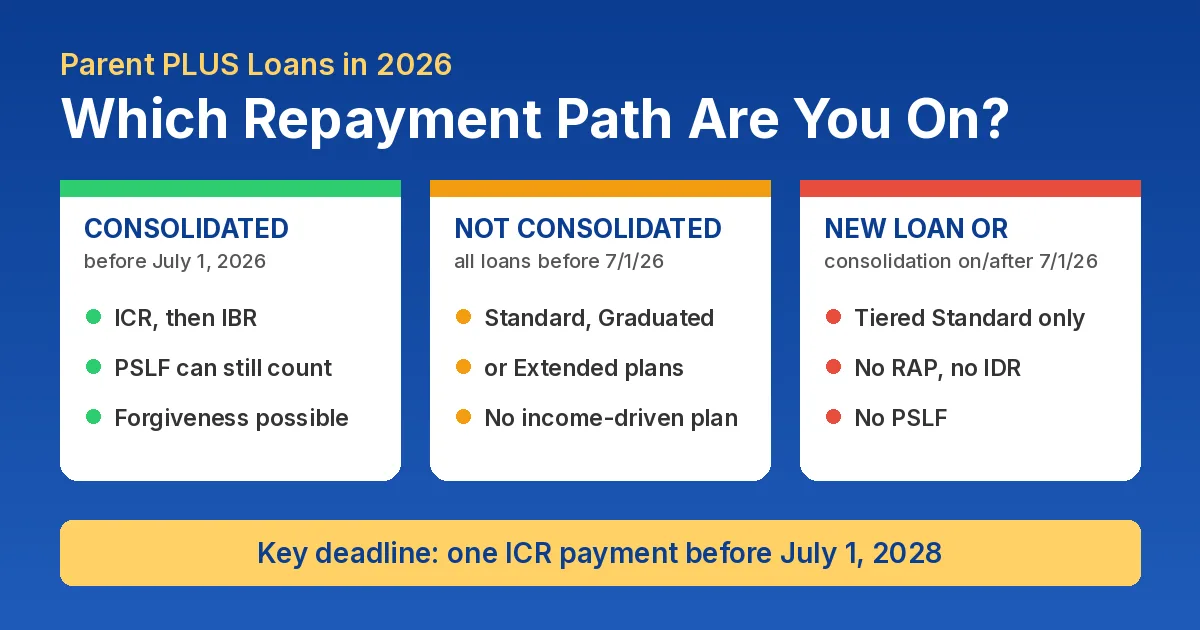
Under the 2025 budget law known as the One Big Beautiful Bill Act, Parent PLUS borrowers fall into three groups. Which group you are in depends on two dates: when your Parent PLUS loans were disbursed, and whether they were consolidated before July 1, 2026. The Federal Student Aid guidance boils down to this:
| Your situation | Repayment plans you can use | Forgiveness paths |
|---|---|---|
| Parent PLUS loans consolidated into a Direct Consolidation Loan disbursed before July 1, 2026, and no new federal loans since | Standard, Graduated, Extended, ICR, and IBR (after at least one ICR payment) | PSLF and income-driven forgiveness remain possible |
| All Parent PLUS loans disbursed before July 1, 2026, never consolidated, and no new federal loans since | Standard, Graduated, Extended | No income-driven forgiveness; the income-driven path through consolidation has closed |
| Any Parent PLUS loan or any Direct Consolidation Loan disbursed on or after July 1, 2026 | Tiered Standard Plan only for the Parent PLUS debt | None through repayment; the Tiered Standard Plan does not qualify for PSLF |
The most important rule for every group: do not take out a new federal student loan or a new consolidation loan without checking what it does to your Parent PLUS debt first.
This is the best position to be in. If your Direct Consolidation Loan was disbursed before July 1, 2026, you can still reach the Income-Based Repayment (IBR) Plan, which bases payments on income and family size and does not end in 2028. But there is a required extra step. Federal Student Aid says you must:
ICR will be eliminated no later than July 1, 2028, so that single ICR payment must be made before ICR ends. Waiting is risky. If you work for a government agency or a qualifying nonprofit, payments on ICR or IBR can also count toward PSLF, which depends on your own job as the parent, not your child's.
Parents who completed a second consolidation (often called double consolidation) before July 1, 2026 may also have Pay As You Earn (PAYE) available, but PAYE also ends no later than July 1, 2028.
If all of your Parent PLUS loans were disbursed before July 1, 2026 and you never consolidated them, you keep the fixed payment plans you already had: the Standard, Graduated, and Extended plans. The window to reach an income-driven plan through consolidation has closed. Consolidating now would not open ICR or IBR. It would move the new loan to the Tiered Standard Plan instead, which is why Student Loan Planner and other experts warn that it is too late to consolidate for income-driven access.
If your payment is too high, there may still be options, including the Extended Plan, deferment or forbearance in a hardship, or a discharge if one applies to you. We review all of those before anything is changed.
Any Parent PLUS loan, and any Direct Consolidation Loan that includes a Parent PLUS loan, disbursed on or after July 1, 2026 can only be repaid on the Tiered Standard Plan. If you already had ICR or IBR set up and then received a new Direct Loan, Federal Student Aid says your servicer will move your Parent PLUS debt to Tiered Standard. Under 20 U.S.C. 1087e, the Tiered Standard term depends on your total outstanding principal:
Payments are fixed, not tied to income, and they do not count toward PSLF. Parent PLUS loans are also shut out of the new Repayment Assistance Plan (RAP).
Parent PLUS loans made on or after July 1, 2026 are capped at $20,000 per year and $65,000 in total for each dependent student, counting amounts already repaid or discharged. Students who were already enrolled in their program and had a federal loan disbursed before July 1, 2026 may qualify for an interim exception that keeps the old limit (cost of attendance minus other aid) for up to three academic years, as long as they stay in the same program. If you are still borrowing for a child in college, remember that a new loan also changes how all of your Parent PLUS debt is repaid.
Repayment plans are only one road. These discharges still apply to Parent PLUS loans, according to the Department of Education:
A discharge review should come before any consolidation decision, because consolidating can change which Borrower Defense rules apply to your loans.
Federal Student Aid says a defaulted loan can only be consolidated if the borrower agrees to an income-driven plan or first makes three consecutive, voluntary, on-time, full monthly payments. A new consolidation loan that includes a Parent PLUS loan cannot use any income-driven plan, so for parents the three payments come first, and the new loan is then repaid on the Tiered Standard Plan. Rehabilitation is the other path. It takes nine reasonable monthly payments and removes the default record from your credit report, but it can generally be used only once.
Involuntary collections, including wage garnishment and tax refund offset, are paused for now, but news reports point to a possible restart in 2027. Our guide to wage garnishment and tax refund offset explains what that could mean, and our comparison of rehabilitation vs. consolidation walks through both paths.
You tell us about your loans once. We do the work:
Default resolution by consolidation is a $495 flat-fee Legal Touch service for eligible borrowers. If consolidation does not fit your situation, we will tell you, and the Department's Default Resolution Group at 1-800-621-3115 can explain rehabilitation and other options for free. You can see all of our loan help services in one place.
Related reading: PSLF buyback, our PSLF guide, and our federal loan consolidation guide.
Yes, but only for some parents. Borrowers whose Parent PLUS loans were consolidated into a Direct Consolidation Loan disbursed before July 1, 2026 can still use ICR and then IBR, which keeps Public Service Loan Forgiveness and income-driven forgiveness possible. Discharges for death, total and permanent disability, closed schools, false certification, and Borrower Defense are still available to Parent PLUS borrowers.
Yes. To use ICR or IBR, the Direct Consolidation Loan had to be disbursed before July 1, 2026. A Direct Consolidation Loan that includes a Parent PLUS loan and is disbursed on or after July 1, 2026 can only be repaid on the Tiered Standard Plan, according to Federal Student Aid.
Federal Student Aid says you must enroll the consolidation loan in the ICR Plan and make at least one payment under ICR before you can switch to IBR. ICR will be eliminated no later than July 1, 2028, so that one ICR payment has to happen before then. You also should not take out any new federal loan, including another consolidation loan, or your servicer will move you to the Tiered Standard Plan.
No. Parent PLUS loans, Direct Consolidation Loans that paid off a Parent PLUS loan, and so called double consolidation loans are all excluded from RAP.
Any new Direct Loan disbursed on or after July 1, 2026 moves all of your Parent PLUS debt to the Tiered Standard Plan, even if you had already set up ICR or IBR. New Parent PLUS borrowing is also capped at $20,000 a year and $65,000 in total per student, unless your student qualifies for the interim exception for students already enrolled before July 1, 2026.
It is a fixed monthly payment. The repayment period depends on your total outstanding principal: 10 years under $25,000, 15 years from $25,000 to under $50,000, 20 years from $50,000 to under $100,000, and 25 years at $100,000 or more. Payments are not based on income, and the plan does not count toward PSLF.
Yes, but the rules are stricter now. A defaulted loan can only be consolidated if the borrower agrees to an income-driven plan or first makes three consecutive, voluntary, on-time, full monthly payments. Because a new consolidation loan with a Parent PLUS loan cannot use an income-driven plan, the three payments are required, and the new loan will be on the Tiered Standard Plan. Rehabilitation, which takes nine reasonable monthly payments, is the other way out of default.
No. The U.S. Department of Education and your loan servicer make every decision. Legal Touch is not a law firm and makes no guarantees. We review your loan history, tell you which group you likely fall into, and handle the paperwork for the options that fit.
Find out which group your Parent PLUS loans fall into, whether you likely qualify for a discharge, and what to avoid before 2028. Check My Eligibility or call 800-261-2946.
Questions first? Contact our team.
Sources: Federal Student Aid, One Big Beautiful Bill Act Updates and Student Loan Consolidation; U.S. Department of Education, Direct PLUS Loan borrower rights and responsibilities; 20 U.S.C. 1087e; NASFAA, What New Parent Borrowers Need to Know; Consumer Financial Protection Bureau; Student Loan Planner.
Legal Touch is not a law firm and does not give legal advice. Results are not guaranteed. Every decision is made by the U.S. Department of Education or your loan servicer, and Legal Touch is not affiliated with any government agency. You can apply for repayment plans, discharges, and default resolution yourself, for free, at StudentAid.gov or through your loan servicer. We will never ask for your StudentAid.gov username or password.

Attorney-formed document preparation for Title IV federal student loan program applications. Not a law firm.


Sales Key LLC dba Legal Touch Borrower Defense · (800) 261-2946 · Copyright . All rights reserved. Designed by Explore Logics
Sales Key LLC dba Legal Touch Borrower Defense, 641 E San Ysidro Blvd Num B3328, San Ysidro, CA 92173