One of the most common questions we hear is whether a school ever finds out about a Borrower Defense claim. It does. The Department of Education notifies the school and gives it a chance to answer with its own documents. In October 2026 that process moved to a new federal system, and the rules for how your school responds depend on when your loans were first paid out. Here is how it works, and why the evidence in your application matters more than ever.
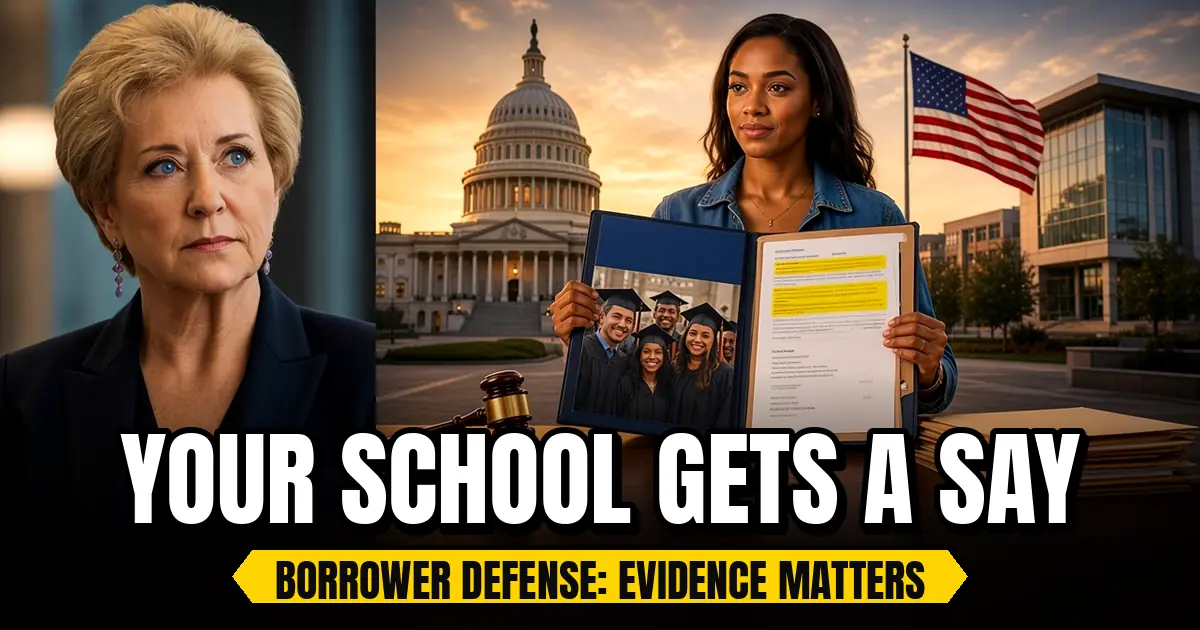
Yes, your school sees your claim. When the Department opens a case on your Borrower Defense application, it emails the school and gives it a window, generally 60 days, to respond and upload evidence. The school does not decide your claim. The Department does, after weighing what you sent against what the school sent.
On September 10, 2026, Federal Student Aid announced in Electronic Announcement ANN-26-23 that starting in October 2026, schools would use a new Borrower Defense portal in FSA Partner Connect to review cases, see which regulation year applies, and upload evidence. Before that, these notices ran through an older system called COD. According to a Thompson Coburn analysis of the Department's guidance:
For you, the practical takeaway is simple. Schools now have a cleaner, faster way to answer claims, with organized evidence categories. Claims that rely on a short story and no documents are likely to be denied when the school answers with paperwork.
Borrower Defense has three rule sets in use, and the one that applies depends on when each loan was first disbursed. In July 2025, Congress kept the 2022 rule from applying to loans first originated before July 1, 2035, so newer loans fall under the 2019 rule (Public Law 119-21). Our full Borrower Defense guide explains each standard. Here is how the school's side works:
| Loan first disbursed | Rule used | How the school responds |
|---|---|---|
| Before July 1, 2017 | 1994 rule | The school generally gets one 60-day window to respond and send evidence. The Department then decides on the record it has. |
| July 1, 2017 to June 30, 2020 | 2016 rule | The school generally gets one 60-day window to respond and send evidence. The Department then decides on the record it has. |
| July 1, 2020 or later | 2019 rule | The school gets at least 60 days to respond. The Department then shares the school's response and evidence with you, and you get at least 60 days to reply before a decision. |
Consolidated loans can change which rule applies, so we check the dates on every loan, including the loans that went into a consolidation. Our FFEL and Perkins guide covers why loan type matters too.
The new portal lists accepted evidence types, including:
Schools can use these to argue that what you were told was accurate, or that the facts were disclosed to you in writing. That is why a claim should name what was said, who said it, roughly when, and how it differed from reality, and back it up with documents wherever possible.
A strong Borrower Defense claim does not rely on your word alone. It ties your experience to the public record about your school: state attorney general settlements, federal lawsuits, Department findings, accreditor actions, and the school's own ads and promises. Our list of schools with Borrower Defense evidence collects that record school by school.
If your loans are under the 2019 rule, timing matters too. Claims must be filed within three years of leaving the school, and you must show the school knew its statements were misleading or recklessly ignored the truth, and that you lost money because of them. See our guide to the 3-year rule.
Under the 2019 rule, the Department sends you the school's response and evidence and gives you at least 60 days to reply. This is a real chance to answer the school point by point. When a Legal Touch client receives a school response, we review every document the school sent, match it against the client's sworn statement and our evidence, and prepare and file the reply before the deadline.
If you are waiting on a decision, our guide to Borrower Defense application status in 2026 explains the stages. If you applied in 2022 or earlier, the Sweet v. McMahon settlement may cover you, and some schools are on the group discharge list, where no application is needed at all. Wondering whether the program is still open? Read Is Borrower Defense still available in 2026?
You tell us about your school once. We do the work:
If your school closed, a closed school discharge may fit better, and we will tell you. See all of our loan help services.
Yes. When the Department of Education opens a case on your application, it notifies the school by email and gives it a set window to respond and send evidence. Since October 2026, schools see and answer these cases in a Borrower Defense portal inside FSA Partner Connect.
No. Only the U.S. Department of Education decides. The school can send its side of the story and its documents, and the Department weighs that against your sworn statement and evidence.
Under the 1994 and 2016 rules, the school generally gets one 60-day window. Under the 2019 rule, the school gets at least 60 days. In the new portal, the upload window closes automatically when the deadline passes, and there is no button to extend it.
The Department's portal lists categories such as affidavits, course catalogs, marketing materials, enrollment agreements, correspondence, loan documents, recruiter training materials and transcripts.
If your loans fall under the 2019 rule (first disbursed on or after July 1, 2020), yes. The Department shares the school's response and evidence with you and gives you at least 60 days to reply. Under the 1994 and 2016 rules, the process generally does not include that reply step.
The decision belongs to the Department of Education, not the school. The Department can try to recover the cost of approved claims from the school, which is one reason schools take these cases seriously.
A school's response does not end a claim. What matters most is whether your claim is backed by specific facts and documents. A short claim with no evidence is likely to be denied, which is why Legal Touch builds every application around documented misconduct. Legal Touch is not a law firm and cannot guarantee any result.
Find out whether your school's record supports a claim and which rule covers your loans. Check My Eligibility or call 800-261-2946.
Questions first? Contact our team.
Sources: Federal Student Aid, ANN-26-23: FSA Partner Connect Training, Borrower Defense to Repayment for Administrators (September 10, 2026, updated September 25, 2026); Thompson Coburn LLP, New ED Guidance Relating to Borrower Defense to Repayment (September 30, 2026); NASFAA, ED Creates New Borrower Defense Portal in Partner Connect (September 14, 2026); Public Law 119-21, Sec. 85001; Federal Student Aid, Borrower Defense.
Legal Touch is not a law firm and does not give legal advice. Results are not guaranteed. Every decision is made by the U.S. Department of Education, and Legal Touch is not affiliated with any government agency. You can apply for Borrower Defense yourself, for free, at StudentAid.gov. We will never ask for your StudentAid.gov username or password.

Attorney-formed document preparation for Title IV federal student loan program applications. Not a law firm.


Sales Key LLC dba Legal Touch Borrower Defense · (800) 261-2946 · Copyright . All rights reserved. Designed by Explore Logics
Sales Key LLC dba Legal Touch Borrower Defense, 641 E San Ysidro Blvd Num B3328, San Ysidro, CA 92173