If you filed a Borrower Defense to Repayment application and have heard nothing for months, or years, you are not alone. One of the most common questions we get in 2026 is simply: "Where is my application?" Here is what the Department of Education is actually doing with Borrower Defense claims right now, how to read your status, what happens to your payments while you wait, and what approval looks like when it comes.
The Department restarted decisions on Borrower Defense applications outside the Sweet settlement in March 2026. Each application first goes to the school, which gets 60 days to respond, and only then is the claim reviewed on the merits. There is no deadline for the Department to decide most applications, and the backlog is still very large, so long waits are normal. If you applied between June 22 and November 16, 2022, you may be covered by court-ordered deadlines under the Sweet settlement instead.
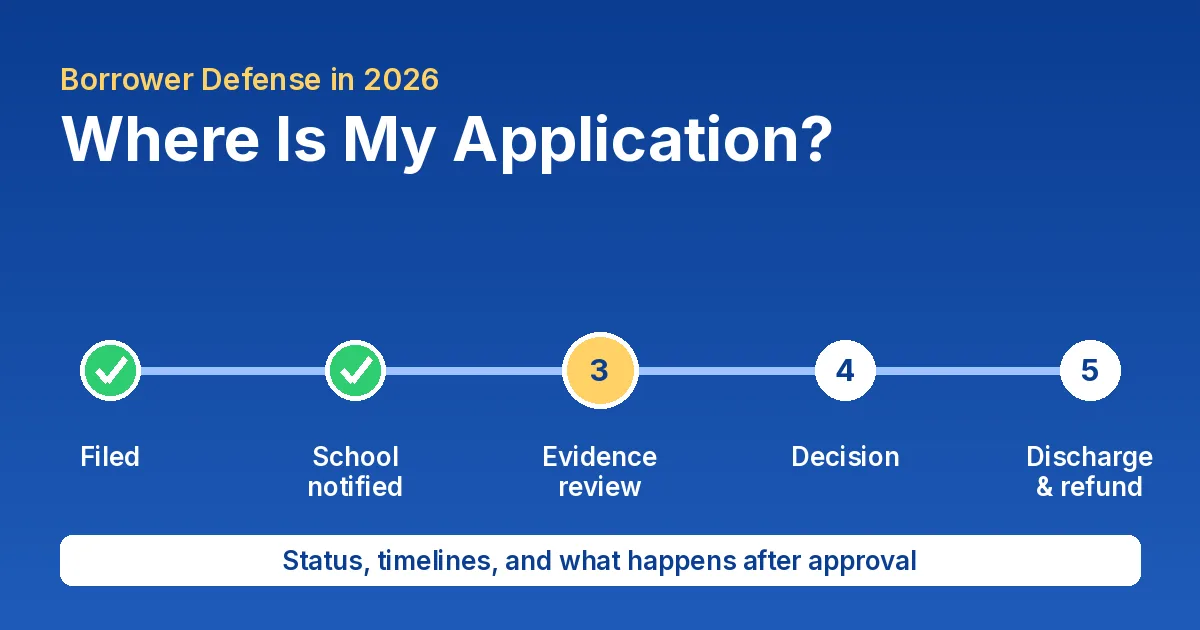
| Where you are | What it usually means |
|---|---|
| Submitted or received | The Department has your application. It may email you if basic details, such as your school name or signature, are missing. |
| Pending, school notified | Your application was sent to the school, which has 60 days to respond. No decision yet. |
| Pending, under review | The notice period is over and the Department is weighing your evidence against the rule that applies to your loan dates. |
| Approved | Your related federal loans will be discharged. A refund of past payments may follow. |
| Denied | The Department found the evidence did not meet the standard. A reconsideration request with new evidence may be possible. |
| Sweet relief notice | You were found eligible for full settlement relief. Relief is supposed to arrive within one year of that notice. |
Status shows in your StudentAid.gov account. The Borrower Defense hotline at 1-855-279-6207 (8 a.m. to 8 p.m. Eastern, Monday through Friday) and BorrowerDefense@ed.gov can also confirm whether an application is on file and where it stands. Every application should have its own application number. Loan servicers such as MOHELA, Aidvantage, and Nelnet do not decide claims and usually cannot tell you when a decision will come.
For Legal Touch clients, we check status for you, confirm the application number, and make sure any new evidence is added to the right file.
When you apply, you can choose an administrative forbearance so you do not have to make payments while the claim is pending. You can also ask for it later through your servicer. Know the tradeoffs before you choose, according to PPSL:
If your loans are in default, they can be placed in stopped collections while your Borrower Defense claim is pending. That pauses involuntary collection, such as wage garnishment and tax refund offsets, until the Department decides.
The tricky part is getting out of default. Consolidation is the usual way out, but a Direct Consolidation Loan made on or after July 1, 2020, is judged under the stricter 2019 Borrower Defense rule, which has a 3-year filing limit counted from the day you left school. For an older claim, consolidating first could likely hurt it. Our article on FFEL loans, Borrower Defense, and consolidation walks through the dates.
That is why Legal Touch always checks your Borrower Defense claim before anything else. If consolidation makes sense once your claim has been reviewed, we handle default resolution by consolidation for $495, if you are eligible. If it does not fit, the Department of Education's Default Resolution Group can be reached at 1-800-621-3115.
Based on the Department's approval notice and servicer guidance, here is the usual order of events:
Until the servicer confirms the discharge, the loans are still owed unless they are in forbearance, deferment, or stopped collections. Missing that detail is one of the most common ways approved borrowers get hurt while they wait.
Borrowers who applied between June 22, 2022, and November 16, 2022, are Sweet "post-class" applicants. The settlement gave the Department until January 28, 2026, to decide applications tied to Exhibit C schools, and a court later set April 15, 2026, for the rest. Applicants with no decision by those dates are entitled to full settlement relief, and on July 17, 2026, the Ninth Circuit rejected the Department's appeal to extend them, according to PPSL's case page. Relief is supposed to arrive within one year of the eligibility notice. Read more in our Sweet settlement guide.
A denial is not always the end. Many denials turn on dates, especially the 3-year filing limit under the 2019 rule, or on missing detail about what the school said. Our guide to Borrower Defense denials and the 3-year rule covers the options. Some schools also qualify for group discharges that do not require an application at all, and our 2026 Borrower Defense update lists the main ones.
You tell us your story once. We do the work:
New to Borrower Defense? Start with our complete Borrower Defense guide and the school misconduct library. Looking at other relief? See Teacher Loan Forgiveness vs. PSLF, SSDI and disability discharge, ways out of default compared, and forgiveness for military, firefighters, and police. Browse all of our Loan Help Services.
There is no set timeline for most applications. The Department of Education resumed reviewing applications outside the Sweet settlement in March 2026, but it first sends each application to the school, which gets 60 days to respond, before the claim is reviewed on the merits. With hundreds of thousands of applications still pending, many people wait a year or more.
You can see it in your StudentAid.gov account, or call the Borrower Defense hotline at 1-855-279-6207 (8 a.m. to 8 p.m. Eastern, Monday through Friday) or email BorrowerDefense@ed.gov. Have your Borrower Defense application number ready. Legal Touch checks status for its clients.
Not necessarily. You can ask for an administrative forbearance while your application is pending. Interest still builds during that forbearance, and the months do not count toward PSLF or income-driven forgiveness. If the claim is approved, that interest is cancelled. If it is denied, you owe it.
Defaulted loans can be placed in stopped collections while the claim is pending, which pauses wage garnishment and tax refund offsets. Be careful about consolidating to get out of default first. A consolidation made on or after July 1, 2020, is judged under the stricter 2019 rule, which can bring in a 3-year filing limit.
The Department tells your loan servicer, and the discharge is usually completed within 60 to 120 days. Your servicer then confirms which loans were forgiven. You may also get a refund of payments you made to the Department on those loans, and the loans are removed from your credit report.
Possibly. Approved borrowers may receive a refund of payments made to the Department of Education on the forgiven loans. Payments made to anyone else, and payments on private loans, are not refunded. If your claim is limited by a statute of limitations, the refund may be reduced or denied.
Possibly. If you applied between June 22, 2022, and November 16, 2022, you are a Sweet post-class applicant. Applicants from Exhibit C schools who had no decision by January 28, 2026, and others with no decision by April 15, 2026, are entitled to full settlement relief. On July 17, 2026, the Ninth Circuit rejected the Department's appeal to extend those deadlines.
No. Nobody can speed up a decision, and Legal Touch makes no guarantees. Legal Touch is not a law firm. What we can do is make sure your application is complete, your evidence is in the file, your payment status is right, and nothing is missed while you wait.
Find out where your claim likely stands and whether anything is missing. Check My Eligibility or call 800-261-2946.
Questions first? Contact our team.
Sources: Federal Student Aid, Electronic Announcement GENERAL-26-22 (March 30, 2026) and GENERAL-26-62 (October 2026); StudentAid.gov Borrower Defense; Department approval notice template; CRI Borrower Defense updates; Project on Predatory Student Lending, Borrower Defense FAQs and Sweet v. McMahon.
Legal Touch is not a law firm and does not give legal advice. Results are not guaranteed. Only the U.S. Department of Education decides Borrower Defense claims, and Legal Touch is not affiliated with it or any government agency. You can apply for Borrower Defense and check your status yourself, for free, at StudentAid.gov. We will never ask for your StudentAid.gov username or password.

Attorney-formed document preparation for Title IV federal student loan program applications. Not a law firm.


Sales Key LLC dba Legal Touch Borrower Defense · (800) 261-2946 · Copyright . All rights reserved. Designed by Explore Logics
Sales Key LLC dba Legal Touch Borrower Defense, 641 E San Ysidro Blvd Num B3328, San Ysidro, CA 92173