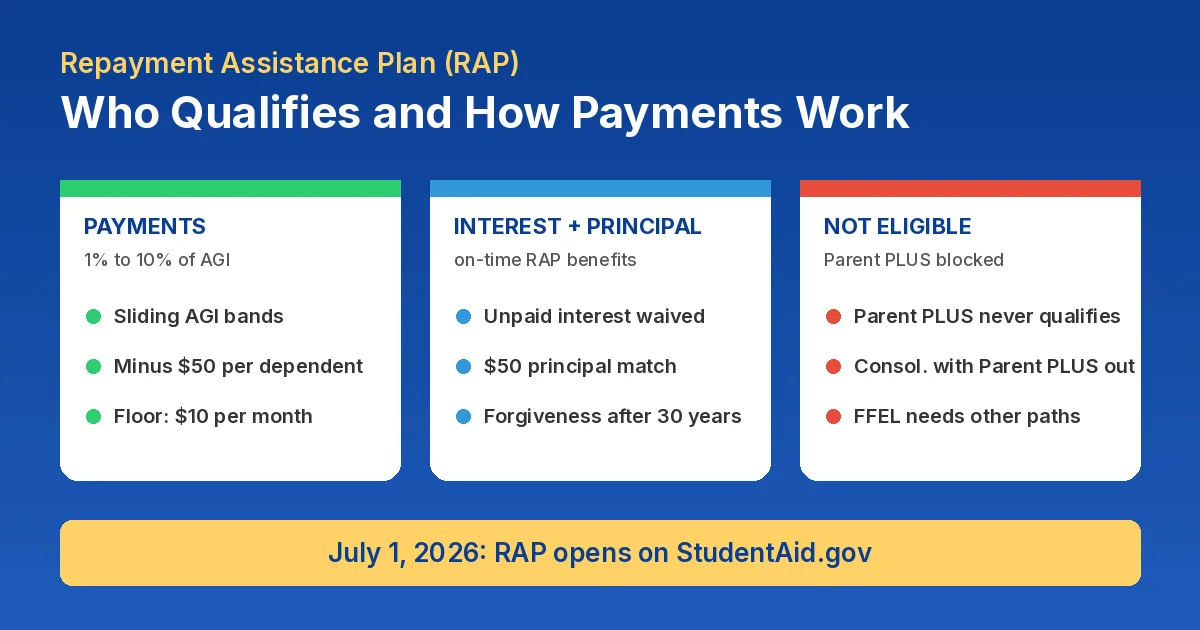
The Repayment Assistance Plan (RAP) is the new income-driven repayment option for eligible Direct Loans. Borrowers can apply beginning July 1, 2026 on StudentAid.gov. Payments use a sliding share of adjusted gross income, unpaid interest can be waived when a full on-time payment is short, and the Department of Education can match principal so balances keep moving. Parent PLUS loans stay out. Here is how RAP works in 2026 and how Legal Touch handles the work for you.

According to Federal Student Aid's IDR FAQ, Edfinancial's RAP page, and the Department of Education fact sheet:
Edfinancial publishes the AGI bands used for RAP. Legal Touch runs the math from the borrower's tax picture and loan file so the estimated payment is clear before anything is filed:
| Adjusted gross income (AGI) | Annual payment base | Notes |
|---|---|---|
| $10,000 or less | $120 per year ($10 per month before dependent credit) | Minimum base before the $50-per-dependent reduction |
| More than $10,000 up to $20,000 | 1% of AGI | Then divide by 12; subtract $50 per dependent claimed on federal taxes |
| More than $20,000 up to $30,000 | 2% of AGI | Same monthly math and dependent credit |
| More than $30,000 up to $40,000 | 3% of AGI | Same monthly math and dependent credit |
| More than $40,000 up to $50,000 | 4% of AGI | Same monthly math and dependent credit |
| More than $50,000 up to $60,000 | 5% of AGI | Same monthly math and dependent credit |
| More than $60,000 up to $70,000 | 6% of AGI | Same monthly math and dependent credit |
| More than $70,000 up to $80,000 | 7% of AGI | Same monthly math and dependent credit |
| More than $80,000 up to $90,000 | 8% of AGI | Same monthly math and dependent credit |
| More than $90,000 up to $100,000 | 9% of AGI | Same monthly math and dependent credit |
| More than $100,000 | 10% of AGI | Monthly payment may not be less than $10 after credits |
Married filing jointly uses combined income, with a reduction if the spouse also has federal student loans. Married filing separately generally uses only that borrower's income and dependents. Legal Touch does not give tax advice. We use the filing facts the borrower already has to estimate the RAP payment and prepare the enrollment.
Two RAP features matter for borrowers whose calculated payment is low relative to interest:
Both benefits depend on making the full RAP payment on time. Legal Touch tracks enrollment status and payment timing with the servicer so those benefits are as likely as the rules allow.
Parent PLUS is the biggest RAP callout for many families. If Parent PLUS is in the file, RAP will not cover it. See our guide to Parent PLUS repayment and forgiveness after July 1, 2026 before counting on RAP for those balances.
Edfinancial reports that the SAVE plan ended by court order on March 10, 2026. PAYE and ICR end no later than July 1, 2028. The Department of Education's fact sheet and Federal Student Aid's IDR FAQ point borrowers toward RAP as the simplified income-driven option going forward. Our earlier overview of what to pick after SAVE ended still helps borrowers who need a bridge plan before RAP opens.
Starting July 1, 2026, borrowers who enroll in auto pay by December 31, 2026 (or who are already enrolled) can receive a 1% interest rate reduction through June 30, 2028. Legal Touch flags auto-pay timing when we set up RAP so that reduction is not missed.
Defaulted loans are not eligible for any income-driven plan, including RAP, until they are out of default. Two common paths:
Which path fits depends on credit goals, timeline, and whether Parent PLUS is mixed into the loans. Legal Touch reviews the file and runs the path that is likely to restore IDR eligibility without guessing.
Under RAP, remaining balance may be forgiven after 30 years (360 months) of qualifying payments. Federal Student Aid's IDR FAQ notes that amounts forgiven may be taxable, especially for discharges on or after January 1, 2026, and some states may also tax forgiven balances. Legal Touch does not give tax advice. Borrowers should confirm tax treatment with a tax professional.
RAP payments can count toward Public Service Loan Forgiveness when other PSLF rules are met, so qualifying public service workers may still reach forgiveness after 10 years of qualifying PSLF payments. Borrowers who need help with forbearance months should also review PSLF Buyback in 2026.
You tell us about your loans, income picture, and goals once. We do the work:
See all of our loan help services in one place. Related reading: after SAVE ended, Parent PLUS after July 1, 2026, and default resolution by consolidation.
RAP is available and can be applied for beginning July 1, 2026 on StudentAid.gov. Legal Touch prepares the application and handles the paperwork. We never ask for a StudentAid.gov username or password.
Federal Student Aid and Edfinancial describe a sliding percentage of adjusted gross income from 1% to 10% by income band. Borrowers at or below $10,000 AGI use a $120 annual base ($10 monthly before credits). That annual amount is divided by 12, then reduced by $50 for each dependent claimed on federal taxes. The monthly payment may not be less than $10.
No. Parent PLUS loans are never eligible for RAP. A Direct Consolidation loan that repaid a Parent PLUS loan, including after a double consolidation, is also ineligible. Families with Parent PLUS should review other repayment and forgiveness options before July 1, 2026.
If a full on-time RAP payment is less than the interest that accrued that month, the unpaid interest for that month is waived or subsidized. That interest does not get added to the balance for that month when the borrower stays current.
If a full on-time RAP payment does not reduce principal by at least $50, the Department of Education makes a matching principal payment so principal drops by at least that amount. The match is not more than $50.
Yes, RAP payments can count toward PSLF when the other PSLF rules are met. Qualifying public service borrowers may still reach forgiveness after 10 years of qualifying PSLF payments. RAP's own remaining-balance forgiveness is after 30 years (360 months) of qualifying payments, and forgiven amounts may be taxable.
No. Defaulted loans are not eligible for any income-driven plan until they are out of default. Two common paths are rehabilitation through the free Default Resolution Group at 1-800-621-3115, then an IDR enrollment, or consolidation into a Direct Consolidation loan with an agreement to repay under RAP. Legal Touch's default resolution by consolidation is a $495 flat-fee service for eligible borrowers.
Edfinancial reports that the SAVE plan ended by court order on March 10, 2026. PAYE and ICR end no later than July 1, 2028. Starting July 1, 2026, RAP becomes the new income-driven option for many Direct Loan borrowers, and for some newer loans it is the only IDR available.
Married filing jointly uses combined income, with a reduction if the spouse also has federal student loans. Married filing separately generally uses only that borrower's income and dependents. Legal Touch reviews the likely filing picture with the loan file; we do not give tax advice.
Find out whether RAP is likely available for your loans, what the AGI-band payment looks like, and which paperwork Legal Touch should handle next. Check My Eligibility or call 800-261-2946.
Questions first? Contact our team.
Sources: Federal Student Aid, FAQs about IDR plans; Edfinancial, Repayment Assistance Plan (RAP); U.S. Department of Education, Fact Sheet: Simplifying Student Loan Repayment.
Legal Touch is not a law firm and does not give legal advice. Results are not guaranteed. Every decision is made by the U.S. Department of Education or your loan servicer, and Legal Touch is not affiliated with any government agency. You can apply for repayment plans, discharges, and default resolution yourself, for free, at StudentAid.gov or through your loan servicer. We will never ask for your StudentAid.gov username or password.

Attorney-formed document preparation for Title IV federal student loan program applications. Not a law firm.


Sales Key LLC dba Legal Touch Borrower Defense · (800) 261-2946 · Copyright . All rights reserved. Designed by Explore Logics
Sales Key LLC dba Legal Touch Borrower Defense, 641 E San Ysidro Blvd Num B3328, San Ysidro, CA 92173