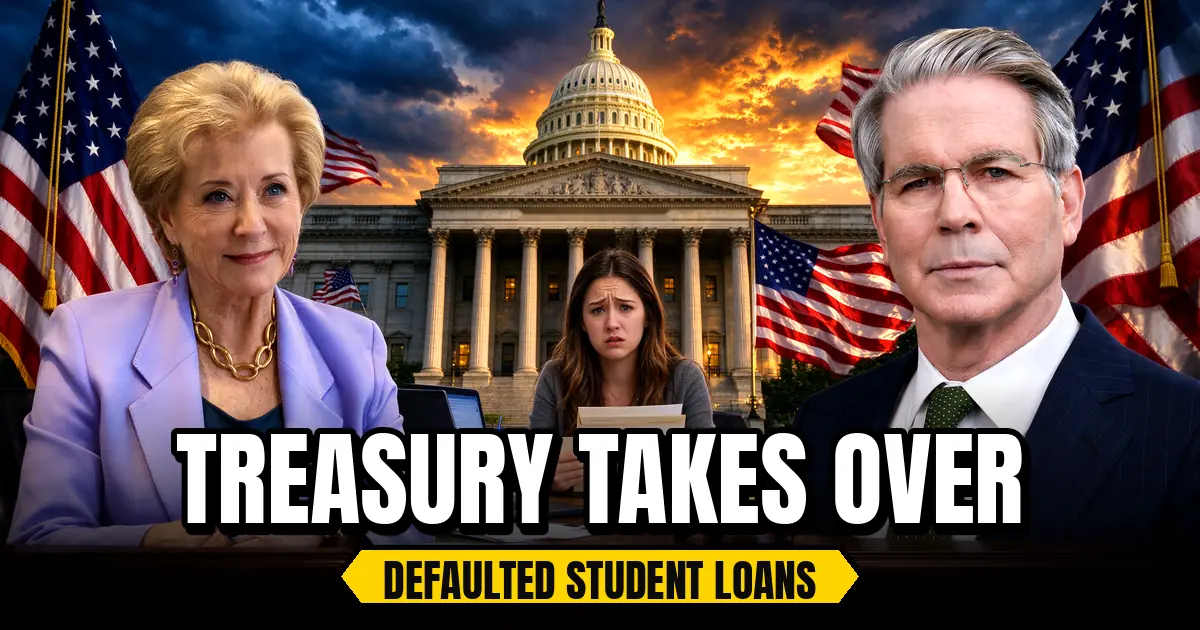
If your federal student loans are in default, the agency on the other end has changed. In 2026 the Treasury Department took over collecting defaulted federal student loans from the Department of Education, and on November 12, 2026, Treasury confirmed it is hiring private debt collectors for the first time in more than six years. Wage garnishment and tax refund seizures are still paused, but news reports point to a return in 2027. Here is what changed, what it means for you, and why now is the time to get out of default.
This page is general information, not legal advice.
On March 19, 2026, the Department of Education and the Treasury Department signed an interagency agreement. In the first phase, Treasury assumed operational responsibility for collecting defaulted federal student loans and for the Federal Student Aid Default Resolution Group, which works directly with borrowers in default. The Department of Education still owns the loans, and the Default Resolution Group phone number, 1-800-621-3115, has not changed (Bureau of the Fiscal Service).
According to a Congressional Research Service report, the plan is to move defaulted loans gradually into Treasury's Cross-Servicing Program, the same system Treasury uses to collect other debts owed to the federal government. About 7.8 million borrowers owed $179 billion in defaulted federal student loans as of December 31, 2025. The Department of Education later reported that roughly 9.3 million borrowers were in default as of June 30, 2026 (CNBC).
| Date | What happened |
|---|---|
| January 16, 2026 | The Department of Education delays involuntary collections, including wage garnishment and the Treasury Offset Program, with no end date. |
| March 19, 2026 | Education and Treasury sign an interagency agreement. Treasury takes operational responsibility for collecting defaulted federal student loans and for the Default Resolution Group. |
| March 20, 2026 | Treasury's Bureau of the Fiscal Service asks the industry for input on hiring "default resolution agents." |
| September 30, 2026 | Treasury and Education launch the Defaulted Loans Support Center on StudentAid.gov, with online rehabilitation and consolidation applications. |
| November 12, 2026 | Treasury confirms it sent a request for quotes to hire private debt collectors for defaulted student loans, the first in more than six years, and plans a new Default Resolution Hub. |
The Department of Education canceled its contracts with private collection agencies in 2021, during the pandemic payment pause, and never replaced them. Since then, the Default Resolution Group has handled defaulted loans on its own.
On November 12, 2026, MarketWatch reported that Treasury sent a request for quotes to collection companies, and a Treasury official confirmed it. The official said a new Default Resolution Hub "will be designed to take the lead in assisting borrowers with rehabilitation or consolidation," and that the companies "will play a supporting role, including ensuring that borrowers are informed of all their options." The proposal would pay companies an extra $20 for each borrower they help through rehabilitation or consolidation, far less than the roughly $1,700 paid per completed rehabilitation under older contracts, according to experts quoted in the report. Some advocates worry that pay structure will push collectors toward payment plans that keep borrowers in default instead of helping them out of it.
Contracts had not been announced as of mid-November 2026, and Treasury has not said when collection calls will start.
Not yet. In its January 16, 2026 announcement, the Department of Education said involuntary collections, including Administrative Wage Garnishment and the Treasury Offset Program, would be delayed while it put the new repayment rules in place. It did not give an end date, and it said defaults are still reported to the credit bureaus.
The pause is not expected to last forever. Stateline reported on November 12, 2026 that borrowers in default are likely to face wage garnishment and seizure of tax refunds next year, and one nonprofit adviser it quoted said she expects collections to start in 2027. When they return, the tools are serious:
Our guide to wage garnishment and tax refund offset explains the notices, hearing rights and deadlines in detail.
New collection contracts usually bring a wave of scam calls and texts. If someone contacts you about a defaulted student loan:
On September 30, 2026, Treasury and the Department of Education launched the Defaulted Loans Support Center on StudentAid.gov, where borrowers can compare options and apply online for rehabilitation or consolidation (Treasury announcement). Treasury says approved rehabilitation applications rose 69 percent and consolidations out of default rose 95 percent in fewer than six months of the partnership. The main paths are:
A new Direct Consolidation Loan pays off the defaulted loans, which can end the default in weeks to a couple of months. For consolidation loans made on or after July 1, 2026, the income-driven option is the Repayment Assistance Plan (RAP), unless three on-time monthly payments are made on the defaulted loan first. The default record can stay on your credit report. Legal Touch handles default resolution by consolidation for a $495 flat fee.
Rehabilitation takes nine affordable monthly payments within ten months. When it is done, the record of the default comes off your credit report, though earlier late payments stay. Right now each loan can be rehabilitated only once, and that rises to twice starting July 1, 2027. Rehabilitation is free through the Department of Education's Default Resolution Group at 1-800-621-3115. See rehabilitation vs. consolidation.
Some borrowers in default do not have to repay at all. If your school misled you, a Borrower Defense claim may fit. If your school closed, see closed school discharge vs. Borrower Defense. If you have a disability or receive SSDI, see TPD discharge. These discharges are not taxable on your federal return (discharge taxes in 2026).
Paying in full also ends a default, but few borrowers in default can do that. Whatever path fits, checking first matters: consolidation can change which Borrower Defense rule applies to your loans, and some old consolidation loans have special limits.
You tell us about your loans once. We do the work:
If rehabilitation fits you better, we will tell you, and you can set it up for free with the Default Resolution Group at 1-800-621-3115. See all of our loan help services.
Since March 19, 2026, the Treasury Department has had operational responsibility for collecting defaulted federal student loans under an agreement with the Department of Education. Treasury also oversees the Default Resolution Group, which you can still reach at 1-800-621-3115. The Department of Education still owns the loans.
Yes. On November 12, 2026, MarketWatch reported, and a Treasury official confirmed, that Treasury sent a request for quotes to private debt collectors for defaulted federal student loans. It is the first time in more than six years. Contracts had not been announced as of mid-November 2026.
No. The Department of Education delayed wage garnishment and Treasury offsets on January 16, 2026, and no restart date has been announced as of mid-November 2026. News reports say collections are likely to return in 2027.
It is a new unit Treasury described in November 2026. A Treasury official said it "will be designed to take the lead in assisting borrowers with rehabilitation or consolidation," with private collectors in a supporting role. Treasury has not announced when it will open.
It is an online portal on StudentAid.gov that Treasury and the Department of Education launched on September 30, 2026. It explains default, compares the ways out, and accepts online applications for loan rehabilitation and consolidation.
Do not give out personal or payment information to someone who calls you first. Hang up and check your account through StudentAid.gov or by calling the Default Resolution Group at 1-800-621-3115. The government never charges a fee to apply for rehabilitation or consolidation.
For many borrowers it is consolidation into a new Direct Consolidation Loan, which can end the default in weeks to a couple of months. Rehabilitation takes nine monthly payments over ten months but can remove the default record from your credit report. Legal Touch handles default resolution by consolidation for a $495 flat fee, and rehabilitation is free through the Default Resolution Group at 1-800-621-3115.
No. Legal Touch is a private company. It is not a law firm, not a collection agency and not affiliated with the Department of Education or the Treasury. You can apply for these programs yourself for free at StudentAid.gov.
No. Legal Touch cannot guarantee any result. The Department of Education, Treasury and your loan holder make every decision. We review your records, prepare and file the paperwork for you, and follow up until there is a decision.
Find out where your defaulted loans stand and the fastest way out before collections return. Check My Eligibility or call 800-261-2946.
Questions first? Contact our team.
Sources: U.S. Department of Education, Delays Involuntary Collections (January 16, 2026); Treasury and Education, Federal Student Assistance Partnership fact sheet (March 19, 2026); Congressional Research Service, Transition of Servicing Defaulted Federal Student Loans to the Department of the Treasury, R48962 (June 9, 2026); U.S. Treasury, Launch of the Defaulted Loans Support Center (September 30, 2026); CNBC (September 30, 2026); MarketWatch, Trump administration is hiring debt collectors for first time in 6 years (November 12, 2026); Stateline (November 12, 2026); Bureau of the Fiscal Service, Federal Student Loans.
Legal Touch is not a law firm and does not give legal or tax advice. Results are not guaranteed. Every decision is made by the U.S. Department of Education, the Treasury Department or your loan holder, and Legal Touch is not affiliated with any government agency or collection agency. You can apply for these programs yourself, for free, at StudentAid.gov. We will never ask for your StudentAid.gov username or password.

Attorney-formed document preparation for Title IV federal student loan program applications. Not a law firm.


Sales Key LLC dba Legal Touch Borrower Defense · (800) 261-2946 · Copyright . All rights reserved. Designed by Explore Logics
Sales Key LLC dba Legal Touch Borrower Defense, 641 E San Ysidro Blvd Num B3328, San Ysidro, CA 92173