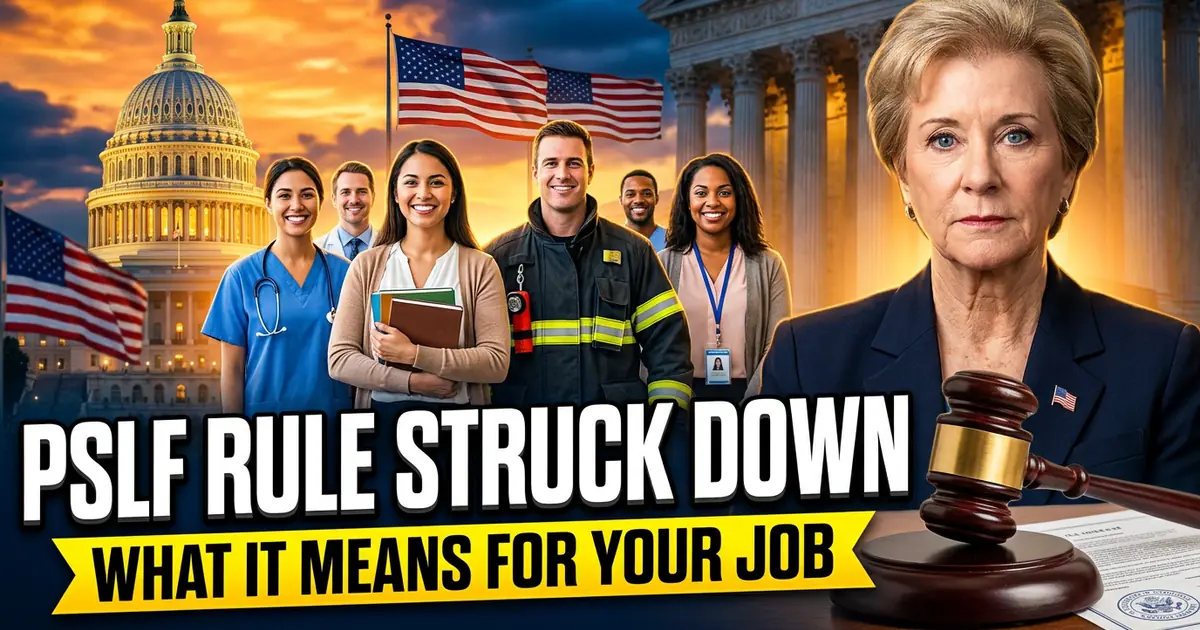
For most of 2026, public service workers heard that Public Service Loan Forgiveness (PSLF) might be cut off for some employers. A Department of Education rule would have let the government disqualify employers it found had a "substantial illegal purpose." That rule never took effect. Federal courts struck it down on June 30, 2026, and in October the government dropped every appeal. Here is what happened, what it means for your job, and what PSLF still requires.
This page is general information, not legal advice.
The Department of Education published the final rule on October 31, 2025 (90 FR 48966). It added a new test to the PSLF regulation at 34 CFR 685.219. If the Secretary found that an employer engaged in certain listed activities so that it had a "substantial illegal purpose," the employer would stop being a qualifying PSLF employer.
The listed activities included aiding or abetting violations of federal immigration law, illegal discrimination, supporting terrorism, trafficking, and violating state law, among others. Under the rule, no payment made on or after July 1, 2026 would count toward PSLF for any month you worked for an employer after it lost its status. You would still have kept credit for work done before that decision, and the rule said a borrower could not ask the Department to reconsider an employer decision.
Supporters said the rule protected taxpayers. Critics said the phrase was broad enough to target nonprofits, hospitals, schools and local governments whose work the administration opposed. Workers at legal aid groups, health systems and advocacy nonprofits were among those worried about losing access to the program.
Lawsuits were filed within days. A coalition of states and the District of Columbia sued in Massachusetts, a group of nonprofits, unions and cities filed a separate case there, and another group of plaintiffs sued in Washington, D.C.
On June 30, 2026, U.S. District Judge Myong J. Joun in Massachusetts vacated the rule. He held that the Department exceeded its legal authority, acted arbitrarily and capriciously, and violated the First Amendment (case summary). A federal judge in Washington, D.C. also vacated the rule the same day. NASFAA reported that the rule was vacated hours before its July 1 effective date.
| Date | What happened |
|---|---|
| October 31, 2025 | The Department of Education publishes the final rule (90 FR 48966), set to take effect July 1, 2026. |
| November 3 and 4, 2025 | Lawsuits are filed by a coalition of states and the District of Columbia, by nonprofits, unions and cities, and by a separate group of plaintiffs in Washington, D.C. |
| June 30, 2026 | Federal judges in Massachusetts and Washington, D.C. vacate the rule, one day before it was set to take effect. |
| July 1, 2026 | The planned effective date passes with no rule in force. |
| August 27, 2026 | The government appeals the rulings. |
| October 21 and 22, 2026 | The government and the plaintiffs file joint stipulations to dismiss all three appeals. |
| October 26 and 30, 2026 | The D.C. Circuit grants dismissal of the D.C. appeal, and the First Circuit enters judgment dismissing the states' appeal. |
Yes. The government appealed in August 2026, then reversed course. On October 21, 2026, it filed joint stipulations to dismiss its appeals in the nonprofits' First Circuit case and in the D.C. Circuit case. On October 22, 2026, the government and the states filed a joint stipulation to dismiss the last appeal, Commonwealth of Massachusetts v. U.S. Department of Education, No. 26-1973, with each side paying its own fees and costs. The Oregon Department of Justice records that the government dismissed that appeal on October 22.
That leaves the June 30 rulings in place, and the rule will not be put into effect. As NASFAA explained, the Department is not required to formally rescind the rule, so the vacated wording may still show up in the Code of Federal Regulations for a while, but it cannot be enforced. The Department could try a new rule, but the court findings would limit it, and a copy of the old rule would likely be challenged again.
If you were thinking about leaving a nonprofit or public job to protect your PSLF progress, the vacated rule is no longer a reason to move. The existing employer rules control. Government organizations at the federal, state, local and tribal level and 501(c)(3) nonprofits continue to qualify, along with the other employer types the program already covered (The College Investor; Harmon Curran).
That includes the jobs most people think of first: public school teachers, nurses at nonprofit hospitals, firefighters, police officers, military service members, social workers and government staff. If you are a teacher, see Teacher Loan Forgiveness vs. PSLF. If you serve in uniform, see options for military, firefighters and police.
The court rulings did not add a single qualifying payment to anyone's count. To reach Public Service Loan Forgiveness you still need:
Requests with uncertified employment, loans that were never consolidated into Direct Loans, or months on a non-qualifying plan are likely to be denied or delayed. If you are short on months because of forbearance, PSLF Buyback may let you pay for some of them.
If your loans are in default, they need to be out of default first. Legal Touch handles default resolution by consolidation for a $495 flat fee. Loan rehabilitation is also an option, and it is free through the Department of Education's Default Resolution Group at 1-800-621-3115. See rehabilitation vs. consolidation to compare.
Public Service Loan Forgiveness is also not taxable on your federal return. See student loan discharge taxes in 2026.
You tell us about your loans and your work history once. We do the work:
See all of our loan help services, or start with our PSLF help service.
No. Public Service Loan Forgiveness is written into federal law, and nothing in 2026 ended it. The court fight was over a 2025 Department of Education rule about which employers could qualify. That rule was vacated in June 2026, and the government dropped its appeals in October 2026.
It was a final rule published on October 31, 2025 that would have let the Secretary of Education decide that an employer had a "substantial illegal purpose" and was no longer a qualifying PSLF employer. Payments made after that decision would not have counted while you worked there.
No. Federal courts in Massachusetts and Washington, D.C. vacated it on June 30, 2026, before its July 1, 2026 effective date. The government later dismissed all three of its appeals, so those rulings stand.
The existing employer rules still apply. Government organizations and 501(c)(3) nonprofits continue to qualify, along with the other employer types the program already covered. Whether your specific employer and job qualify still depends on those rules and your own records.
It could try a new rule, but the courts found the 2025 rule exceeded the Department's authority and violated the First Amendment, which would limit any new version. A rule that closely mirrors the old one would likely face new lawsuits. The vacated language may still appear in the Code of Federal Regulations until the Department removes it, but it cannot be enforced.
No new step is required by the rulings. It still makes sense to keep your employment certified at least once a year and after any job change, stay on a qualifying repayment plan, and check that your payment count is right.
Yes. RAP payments can count toward PSLF when the other PSLF rules are met, along with payments under IBR and the other qualifying plans.
No. Public Service Loan Forgiveness is not treated as taxable income on your federal return. See our guide to student loan discharge taxes in 2026 for how other discharges are treated.
No. Legal Touch is not a law firm and cannot guarantee any result. The Department of Education and your loan servicer make every decision. We review your records, prepare and file the paperwork for you, and follow up until there is a decision.
Find out where your PSLF count really stands and what is missing. Check My Eligibility or call 800-261-2946.
Questions first? Contact our team.
Sources: Federal Register, PSLF final rule, 90 FR 48966 (October 31, 2025); NASFAA, Federal Court Vacates PSLF Final Rule and Trump Administration Abandons PSLF Final Rule (October 23, 2026); First Circuit No. 26-1973, joint stipulation to dismiss appeal (October 22, 2026); Oregon Department of Justice litigation tracker; Civil Rights Litigation Clearinghouse, Commonwealth of Massachusetts v. U.S. Department of Education; The College Investor (October 21, 2026); Harmon Curran (November 3, 2026); Federal Student Aid, Public Service Loan Forgiveness.
Legal Touch is not a law firm and does not give legal or tax advice. Results are not guaranteed. Every decision is made by the U.S. Department of Education or your loan servicer, and Legal Touch is not affiliated with any government agency. You can apply for these programs yourself, for free, at StudentAid.gov. We will never ask for your StudentAid.gov username or password.

Attorney-formed document preparation for Title IV federal student loan program applications. Not a law firm.


Sales Key LLC dba Legal Touch Borrower Defense · (800) 261-2946 · Copyright . All rights reserved. Designed by Explore Logics
Sales Key LLC dba Legal Touch Borrower Defense, 641 E San Ysidro Blvd Num B3328, San Ysidro, CA 92173