You enrolled to become a doctor. But what happens when the dream of practicing medicine leaves you struggling with overwhelming student loan debt?
If you attended Ross University School of Medicine (RUSM), there are important legal developments and federal student loan disclosures you should know about.
Ross University School of Medicine has faced litigation involving allegations of misleading representations to students. The school is also specifically named in Exhibit C of the Sweet v. Cardona settlement, an important federal student loan settlement.
For some former students, these developments may provide valuable context when investigating eligibility for Borrower Defense to Repayment, a federal student loan discharge program.
One of the most important developments for former Ross University students is the school's inclusion in the historic Sweet v. Cardona borrower defense settlement.
Ross University School of Medicine appears by name in Exhibit C, under the DeVry school group.
The settlement provided substantial federal student loan relief to qualifying borrowers who had submitted Borrower Defense applications within the applicable settlement deadlines.
Why this matters: Ross University's inclusion identifies it as one of the institutions covered by the settlement's school-based relief provisions. However, Exhibit C does not establish that every student was defrauded, and it does not automatically qualify new applicants for loan forgiveness.
👉 Official Source: U.S. Department of Education — Sweet v. Cardona Settlement Agreement, Exhibit C, PDF page 38
In Awodiya v. Ross University School of Medicine, a former medical student alleged that the university made misleading statements about its disability accommodation practices.
The student argued that the school's published representations influenced his decision to enroll.
In May 2021, the U.S. Court of Appeals for the Eleventh Circuit reversed the dismissal of his fraudulent inducement claim, finding sufficient conflicting evidence for that claim to proceed.
Why this matters: The litigation illustrates how published school policies and enrollment-related statements can become central to allegations of misleading recruitment or inducement.
The appeals court did not determine that Ross committed fraud. Whether another borrower's experience supports a Borrower Defense claim depends on the particular representations, evidence, and resulting harm.
👉 Court Source: Awodiya v. Ross University School of Medicine — Eleventh Circuit Decision, 2021
Medical school can be expensive, but the federal government's disclosures concerning Ross University School of Medicine are especially important for prospective and former borrowers.
According to the U.S. Department of Education's published figures for 2023:
These numbers are not proof of misconduct. However, they demonstrate why transparent information about educational costs, completion timelines, academic requirements, and career outcomes can be crucial to a student's enrollment and borrowing decisions.
👉 Official Source: Federal Student Aid — Ross University School of Medicine Financial and Completion Data
In June 2024, the U.S. Department of Education issued Ross University School of Medicine a provisional federal student aid participation agreement containing significant financial and reporting requirements.
The agreement stated that the institution did not meet federal financial responsibility standards under 34 CFR 668.171.
As a condition of participation, Ross was required to provide financial protection equal to at least 10% of its applicable annual federal student aid funds.
The agreement also required reporting of certain accreditor actions, government proceedings, investigations, and class action litigation.
Why this matters: These documented federal oversight conditions provide important institutional background for students researching the school. They do not, by themselves, prove deceptive recruitment or establish eligibility for Borrower Defense relief.
👉 Official Source: U.S. Department of Education — Ross University School of Medicine Provisional Program Participation Agreement, 2024
Possibly. Your experience with the school matters.
The federal Borrower Defense to Repayment program allows eligible borrowers to request discharge of federal student loans when their schools engaged in qualifying misconduct.
Former Ross University School of Medicine students may have grounds to investigate a claim if they experienced misleading statements or omissions concerning:
A successful application generally requires evidence connecting qualifying school misconduct to the borrower's enrollment or borrowing decisions. The specific legal requirements depend on the applicable federal regulations.
Official Resource: U.S. Department of Education — Borrower Defense to Repayment
You invested in an education because you believed it would lead to a medical career. If important information about that education was misrepresented, you deserve to understand your rights.
Your medical education may be in the past. Your opportunity to investigate federal student loan relief may not be.
Take the next step today:
You worked hard for your future. Find out whether your federal student loans deserve a second look:
✅ Check your eligibility now
OR
✅ Get expert help with your claim
OR
✅ Start your loan relief request today
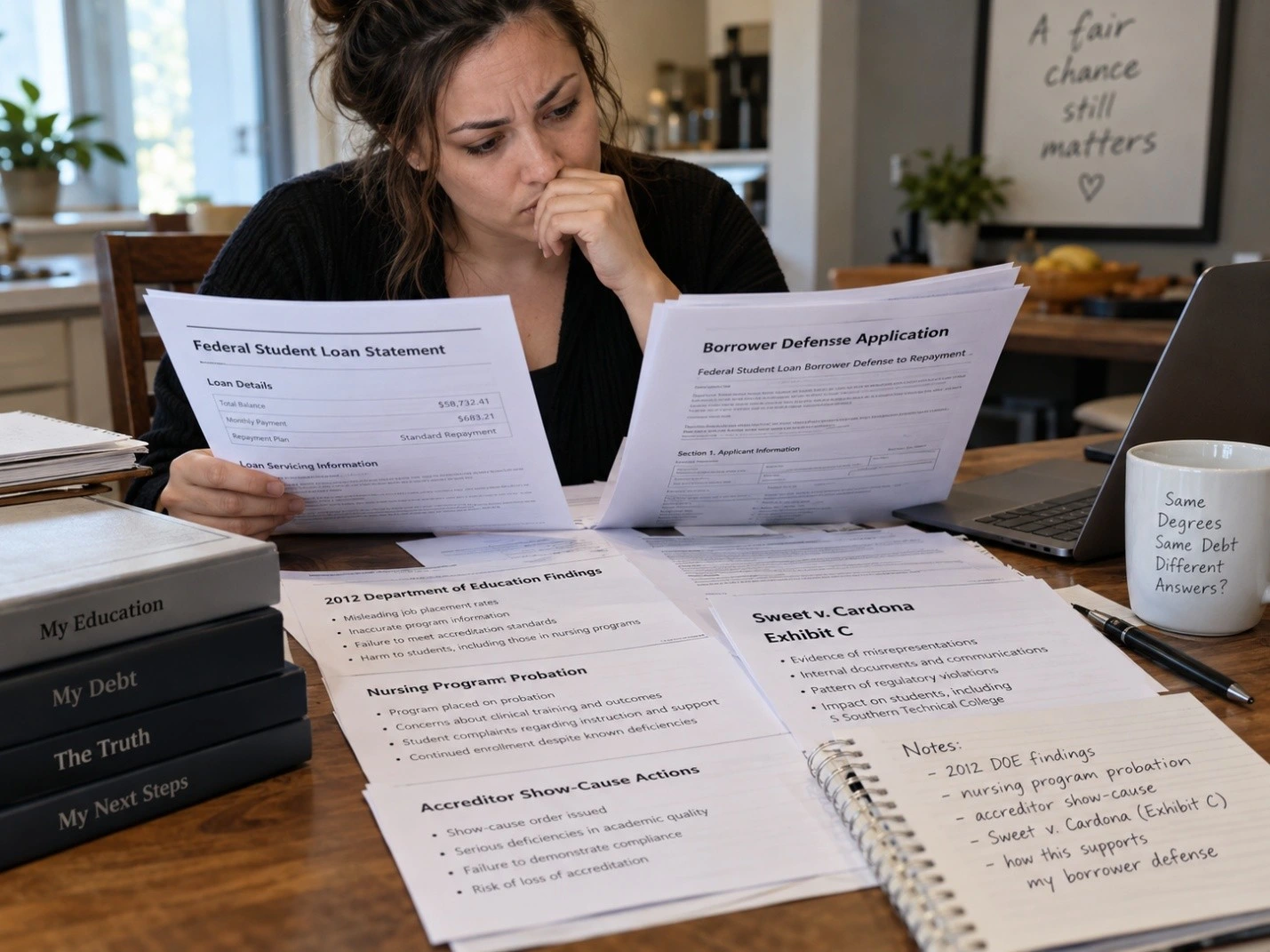
Southern Technical College faced federal financial aid findings, nursing probation, and accreditor scrutiny. Explore Sweet v. Cardona and loan forgiveness options....
Read More...
Attended Remington College? Federal investigations, a DOJ settlement, recruiting complaints and Sweet v. Cardona records may matter for Borrower Defense...
Read More...
Attended Purdue University Global or Kaplan University? Learn about Sweet v. Cardona Exhibit C, government investigations, recruiting concerns, settlements, and potential Borrower Defense student loan relief...
Read More...
Attended New England Institute of Art? Learn about government findings, a major Massachusetts judgment, Art Institutes student loan discharges, and Borrower Defense options....
Read More...
Attended New England College of Business and Finance? Learn about its 2018 Massachusetts AG settlement, recruitment allegations, Sweet v. Cardona listing, and Borrower Defense options....
Read More...
Attended Mount Washington College or Hesser College? See its Sweet v. Cardona listing, Kaplan regulatory history, and Borrower Defense options....
Read More...
Former Missouri College student reviewing federal student loan and Borrower Defense documents after learning about the Career Education Corporation multistate settlement, alleged recruiting and job-placement practices, Missouri College's 2016 closure, and its inclusion in the corrected Sweet v. Cardona Exhibit C...
Read More...
Attended Miller-Motte College? A major student lawsuit, Department of Education references, accreditation actions, and Sweet v. Cardona Exhibit C could provide important evidence for a Borrower Defense claim....
Read More...
Attended Miami-Jacobs Career College? Discover lawsuits, accreditation disputes, Ohio regulatory findings, Sweet v. Cardona, and possible Borrower Defense relief....
Read More...
Attended MedTech College in Indiana? Federal findings, low nursing exam results, regulatory action, school closure, and Sweet v. Cardona may support a Borrower Defense claim....
Read More...
Attended Miami International University of Art & Design? See the federal findings, lawsuits, settlements, and Borrower Defense evidence tied to The Art Institutes and EDMC....
Read More...
Attended McIntosh College? Discover lawsuits, student complaints, Career Education Corporation settlements, Sweet v. Cardona evidence, and Borrower Defense options....
Read More...
The highest level of education and consulting in Borrower Defense for Student Loans.

Legal Touch Borrower Defense - Copyright . All rights reserved. Designed by Explore Logics