If you attended New England College of Business and Finance, or NECB, and were left with federal student loan debt, you may want to explore Borrower Defense to Repayment, a
U.S. Department of Education program that can provide federal student loan relief to eligible borrowers who were harmed by certain misconduct or misleading representations by their school. Public records involving NECB may be relevant when evaluating and supporting an individual Borrower Defense claim.
In 2018, the Massachusetts Attorney General reached a settlement with NECB following allegations involving inadequate disclosures to prospective students and excessive recruitment contacts. Even more significantly for former borrowers, New England College of Business and Finance appears by name in Exhibit C of the Sweet v. Cardona settlement.
Those facts do not automatically mean every former NECB student qualifies for loan discharge. But they may provide important supporting evidence when a borrower's own experience involved similar representations or recruitment practices.
The Massachusetts Attorney General announced a settlement with New England College of Business and Finance on March 22, 2018.
According to the Attorney General, NECB allegedly failed to provide certain required information to prospective students at least 72 hours before enrollment. The disclosures at issue included information concerning:
The Attorney General also alleged that NECB contacted prospective students more frequently than Massachusetts regulations permitted, including repeated telephone calls and text messages characterized by the state as high-pressure recruitment activity.
Under the settlement, NECB agreed to pay $79,000, send revised disclosures to enrolled students, and waive outstanding institutional debt for qualifying students. The U.S. Department of Education later included this Massachusetts enforcement action in federal materials cataloging law-enforcement actions involving colleges.
Borrower Defense is designed for federal student loan borrowers who may have been harmed by certain school misconduct. Current Department of Education application materials specifically address misleading statements and, depending on the applicable regulation, concealed or omitted information concerning areas such as educational programs, costs, and employment outcomes.
If your experience at NECB involved claims about cost, career outcomes, graduation rates, program length, employment prospects, or pressure to enroll quickly, the Massachusetts Attorney General's allegations may be relevant corroborating evidence.
Your strongest Borrower Defense application, however, should connect the public evidence to what actually happened to you.
New England College of Business and Finance also appears in the official Sweet v. Cardona Settlement Agreement Exhibit C, under Willis Stein & Partners, ECA.
The Sweet settlement provided specific forms of relief to qualifying class members who had already submitted Borrower Defense applications within the settlement's applicable deadlines. A school's appearance on Exhibit C is important historical and institutional context, but it does not mean that simply attending NECB now guarantees automatic loan cancellation.
For borrowers filing or pursuing claims today, the key question remains whether their own experience satisfies the Borrower Defense rules applicable to their loans.
California's Bureau for Private Postsecondary Education also lists New England College of Business and Finance, institution code 39819192, with a February 4, 2021 Assessment of Fine and Order of Abatement. The Bureau's current disciplinary-action page marks the matter as non-payment/non-compliance with citation.
This occurred after NECB had been acquired by Cambridge College in March 2020, so borrowers should avoid treating the California citation as proof of misconduct during a particular student's enrollment without examining the underlying dates and facts. Cambridge College confirms that it acquired NECB in March 2020.
Think back to what you were told before enrolling or while deciding whether to remain enrolled.
Were you given misleading or incomplete information about tuition or fees? Were employment statistics or career opportunities presented in a way that influenced your decision? Were graduation rates or program completion times important to you? Did recruiters repeatedly call or text you or make you feel pressured to enroll?
If your answer is yes, preserve anything that can support your account: emails, advertisements, enrollment documents, catalogs, screenshots, financial-aid records, text messages, transcripts, and your recollection of who made each representation and approximately when.
Your personal facts are what turn general evidence about a school into a Borrower Defense claim.
If New England College of Business and Finance misled you about something important to your decision to enroll, remain enrolled, or borrow money, you may want to investigate whether Borrower Defense to Repayment applies to your federal student loans.
Use our Borrower Defense DIY Guide to understand the process and the evidence you may need.
Browse our growing library of school misconduct and Borrower Defense research.
Not sure whether your school is covered? Search the complete list of schools.
You borrowed money expecting the education you were sold to match the representations made to you.
If it didn't, your story deserves to be documented properly.
If New England College of Business and Finance made misleading claims, failed to disclose important information, or used recruitment tactics that influenced your decision to enroll or borrow federal student loans, you may want to investigate whether Borrower Defense to Repayment could apply to your situation.
Don't let uncertainty stop you from reviewing your options. Start by gathering your enrollment records, financial aid documents, emails, advertisements, and anything else that shows what NECB represented to you.
Eligibility and relief depend on each borrower's facts, loan history, applicable Borrower Defense regulations, supporting evidence, and Department of Education review. Inclusion in Sweet v. Cardona Exhibit C by itself does not establish eligibility for a new automatic discharge.
Check your eligibility for FREE today
OR
Talk to our experts now!

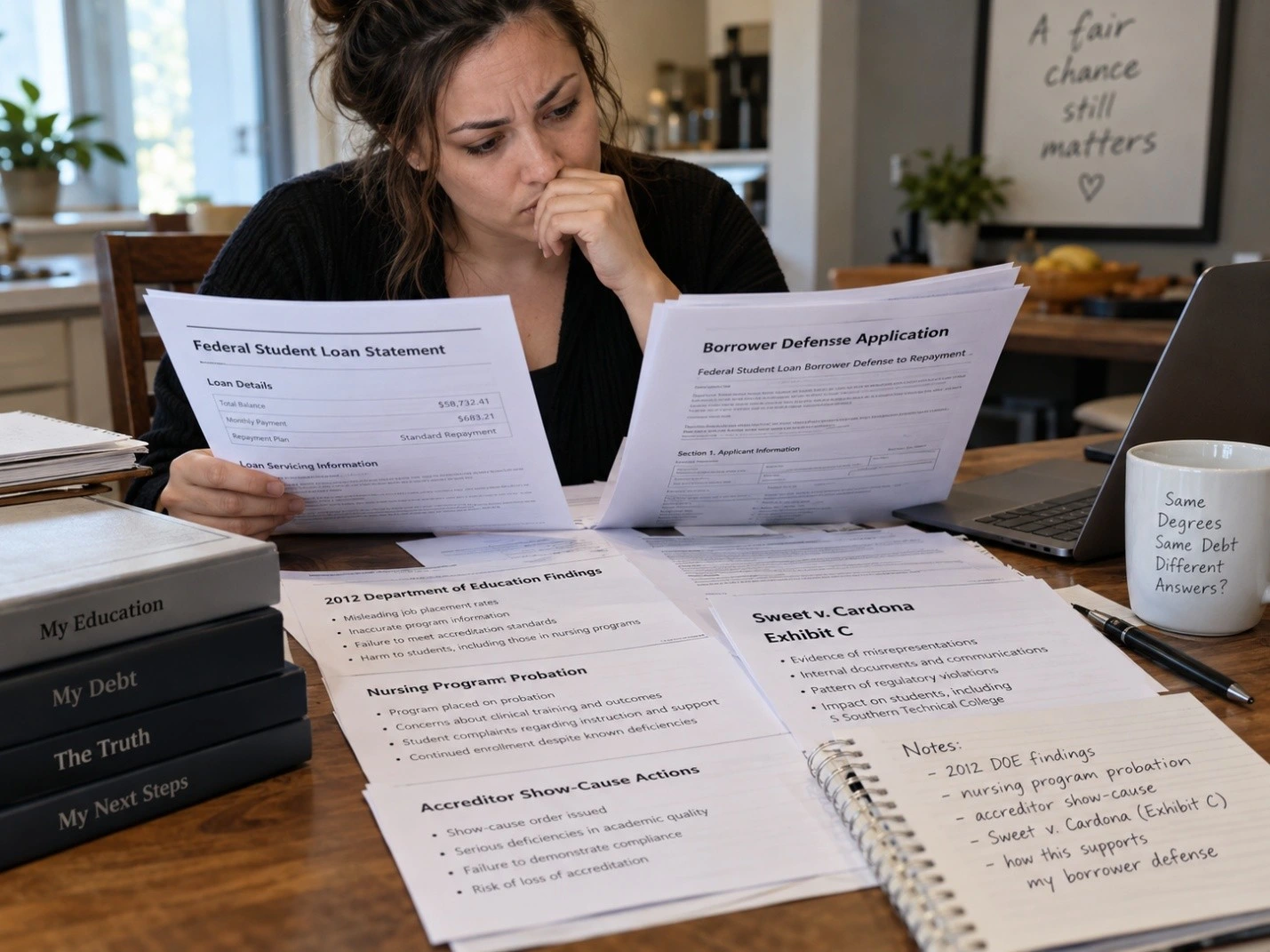
Southern Technical College faced federal financial aid findings, nursing probation, and accreditor scrutiny. Explore Sweet v. Cardona and loan forgiveness options....
Read More...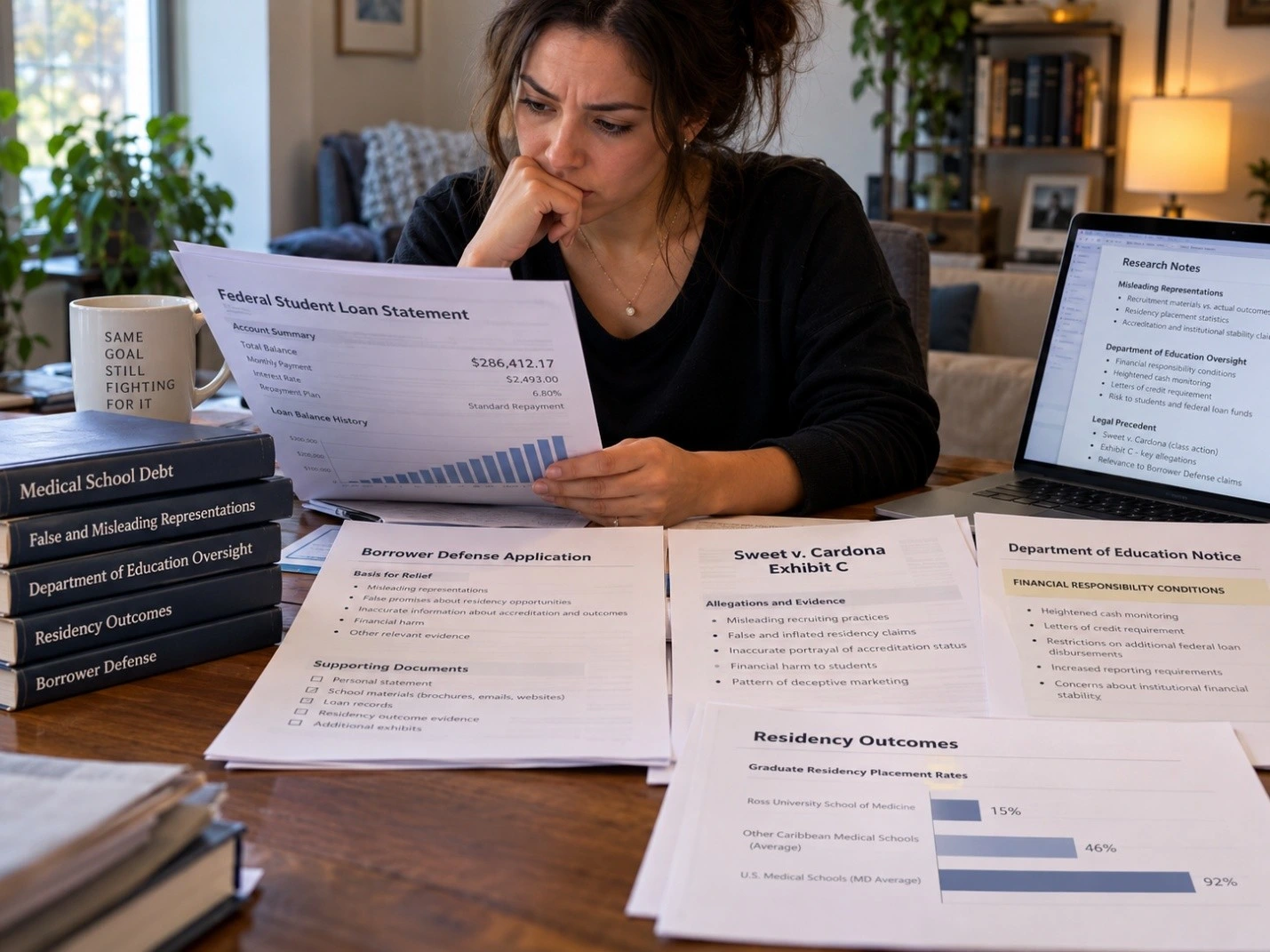
Attended Ross University School of Medicine? Discover lawsuits, student debt concerns, Sweet v. Cardona Exhibit C, and Borrower Defense options....
Read More...
Attended Remington College? Federal investigations, a DOJ settlement, recruiting complaints and Sweet v. Cardona records may matter for Borrower Defense...
Read More...
Attended Purdue University Global or Kaplan University? Learn about Sweet v. Cardona Exhibit C, government investigations, recruiting concerns, settlements, and potential Borrower Defense student loan relief...
Read More...
Attended New England Institute of Art? Learn about government findings, a major Massachusetts judgment, Art Institutes student loan discharges, and Borrower Defense options....
Read More...
Attended Mount Washington College or Hesser College? See its Sweet v. Cardona listing, Kaplan regulatory history, and Borrower Defense options....
Read More...
Former Missouri College student reviewing federal student loan and Borrower Defense documents after learning about the Career Education Corporation multistate settlement, alleged recruiting and job-placement practices, Missouri College's 2016 closure, and its inclusion in the corrected Sweet v. Cardona Exhibit C...
Read More...
Attended Miller-Motte College? A major student lawsuit, Department of Education references, accreditation actions, and Sweet v. Cardona Exhibit C could provide important evidence for a Borrower Defense claim....
Read More...
Attended Miami-Jacobs Career College? Discover lawsuits, accreditation disputes, Ohio regulatory findings, Sweet v. Cardona, and possible Borrower Defense relief....
Read More...
Attended MedTech College in Indiana? Federal findings, low nursing exam results, regulatory action, school closure, and Sweet v. Cardona may support a Borrower Defense claim....
Read More...
Attended Miami International University of Art & Design? See the federal findings, lawsuits, settlements, and Borrower Defense evidence tied to The Art Institutes and EDMC....
Read More...
Attended McIntosh College? Discover lawsuits, student complaints, Career Education Corporation settlements, Sweet v. Cardona evidence, and Borrower Defense options....
Read More...
The highest level of education and consulting in Borrower Defense for Student Loans.

Legal Touch Borrower Defense - Copyright . All rights reserved. Designed by Explore Logics